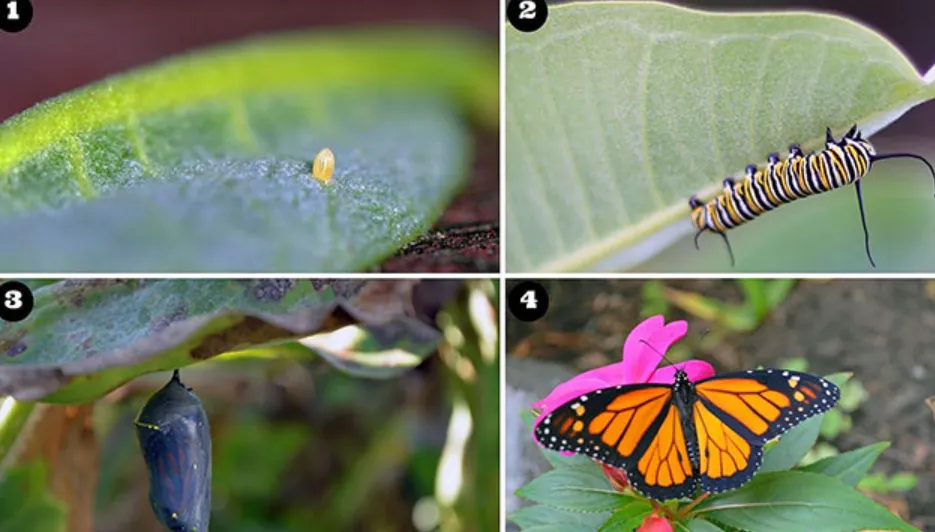
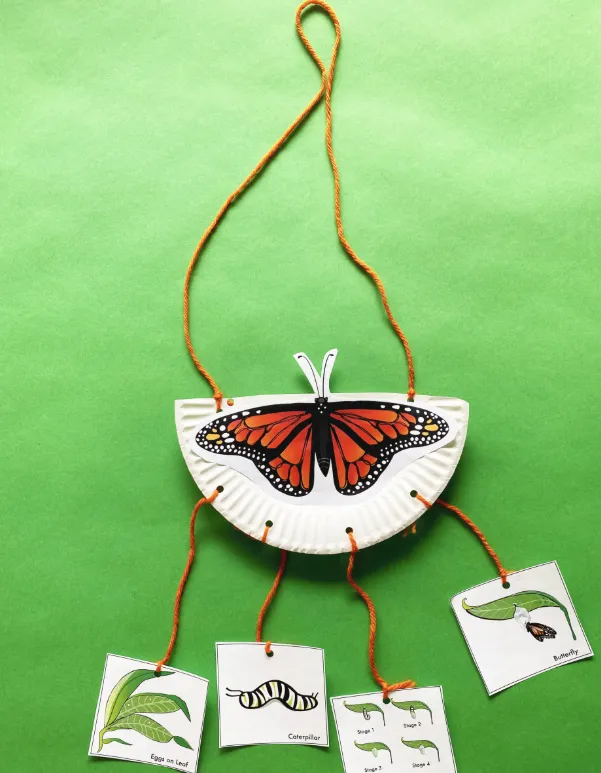
The monarch life cycle is one of the most fascinating transformations in the insect world. A tiny cream-colored egg becomes a striped caterpillar, then a green chrysalis, and finally a bright orange-and-black monarch butterfly. This process is called complete metamorphosis, because the insect changes through four very different stages: egg, larva, pupa, and adult. Monarchs are especially famous because their life cycle is closely connected with milkweed, the only plant where females lay eggs and the only food source for young caterpillars.
Monarchs are also known for their long-distance migration. Eastern North American monarchs can travel across generations between breeding areas in the United States and Canada and wintering forests in central Mexico. Recent winter 2025–2026 data showed eastern monarchs occupied 2.93 hectares in Mexico, a 64% increase from the previous year, but conservation experts still treat their recovery with caution.
Q: How many stages are in the monarch’s life cycle?
A: The monarch has four main stages: egg, caterpillar, chrysalis, and adult butterfly.
Q: What do monarch caterpillars eat?
A: Monarch caterpillars eat only milkweed leaves, making milkweed essential for their survival.
Q: How long does the monarch’s life cycle take?
A: In warm conditions, development from egg to adult can take about 25–30 days, but cooler weather can slow the process.
Quick Life Cycle Table
| Stage | What Happens | Main Food | Approx. Time |
| Egg | A female lays one egg on a milkweed leaf | None | About 3–5 days |
| Larva / Caterpillar | A caterpillar eats, grows, and molts 5 times | Milkweed leaves | About 10–14 days |
| Pupa / Chrysalis | Body transforms inside green chrysalis | Stored energy | About 9–14 days |
| Adult Monarch | Butterfly flies, drinks nectar, mates, migrates | Flower nectar | 2–6 weeks; migratory generation can live months |

The History of Their Scientific Naming
The scientific name of the monarch butterfly is Danaus plexippus. The species was first described by Carl Linnaeus in 1758, originally under the broader butterfly genus Papilio. Later classification placed it in the genus Danaus, which is now used for milkweed butterflies. The U.S. Fish and Wildlife Service also lists the monarch’s scientific name as Danaus plexippus.
Important naming points:
- Danaus is connected with classical Greek naming traditions used in early taxonomy.
- Plexippus is the species name and helps separate monarchs from other Danaus butterflies.
- The common name “monarch” became popular because of the butterfly’s large size, its royal orange color, and its wide range.
- Monarchs belong to the family Nymphalidae, one of the largest butterfly families.
- They are also called milkweed butterflies because their caterpillars depend on milkweed.
This naming history matters because scientific names tend to be more stable than common names. In different regions, people may use different local names, but Danaus plexippus clearly identifies the same species in research, conservation, and education.
Their Evolution And Their Origin
The monarch butterfly‘s origin is closely linked to North America and the spread of milkweed plants. According to the U.S. National Park Service, the monarch species has existed for about one million years. Its ancestors already had traits that supported long-distance flight, suggesting that migratory behavior may be older than modern monarchs themselves.
Around 20,000 years ago, after the peak of the last ice age, warming climates allowed milkweed to spread into new areas. Monarchs followed this host plant, expanding their range into Central America, South America, the Caribbean, parts of the Atlantic region, Europe, and the South Pacific. This shows how deeply the monarch’s survival is tied to the availability of milkweed habitat.
Their evolution also shows a powerful example of coevolution. Milkweed contains toxic compounds called cardiac glycosides. Many animals avoid these toxins, but monarch caterpillars developed resistance. By feeding on milkweed, caterpillars store chemical defenses that make them less attractive to predators.
This relationship shaped both organisms. Milkweed developed chemical defenses, and monarchs adapted to use them for protection. Over time, this gave monarchs a survival advantage and created one of the most famous plant-insect relationships in nature.
Their main food and its collection process
Food is central to the monarch’s life cycle, but monarchs do not eat the same food at every stage. Caterpillars and adults have different needs.
Important food points:
- Monarch caterpillars eat only milkweed leaves. This makes milkweed the most important plant in the early life cycle. Without milkweed, female monarchs have nowhere suitable to lay eggs, and caterpillars cannot survive.
- Adult monarchs drink nectar from flowers. Nectar gives them sugar-rich energy for flying, mating, and migration. They need many blooming plants throughout spring, summer, fall, and the overwintering period.
- Caterpillars collect food by chewing leaves. After hatching, the tiny larva first eats part of its eggshell, then begins feeding on milkweed. As it grows, it eats more leaf tissue and sheds its skin several times.
- Adults collect food using a proboscis. The proboscis is a long, straw-like mouthpart. The butterfly uncoils its wings to sip nectar from flowers.
- Milkweed also works as protection. The toxins inside milkweed help monarch caterpillars and adult butterflies become distasteful to many predators.
A healthy monarch habitat needs both milkweed for caterpillars and nectar flowers for adults. Planting only flowers is helpful, but it does not replace the need for native milkweed. Similarly, planting milkweed without nectar flowers may not fully support adult monarchs during breeding and migration.
Important Things That You Need To Know
The word monarch can describe different things in general English, but in this article, it refers to the monarch butterfly, scientifically known as Danaus plexippus. This insect is one of the most recognizable butterflies in North America because of its orange wings, black veins, and white-spotted borders.
A monarch is not just beautiful; it is also biologically important. Its life depends on milkweed, and its migration depends on connected habitats across large landscapes. That means farms, gardens, roadsides, meadows, city parks, and forest edges can all influence monarch survival.
One important fact is that not all monarchs migrate the same way. Eastern monarchs usually migrate toward wintering forests in central Mexico, while western monarchs overwinter mainly along the California coast and parts of northern Baja California. Western monarch numbers remain very low. The 2025 mid-season Western Monarch Count recorded about 12,260 monarchs across 249 sites, and the late-season 2025–2026 count recorded 6,464 monarchs across 193 sites.
You also need to know that the monarch is a conservation concern. The IUCN classifies migratory monarchs as Vulnerable, and major threats include habitat loss, pesticides, and climate change.
Their life cycle and ability to survive in nature
Egg Stage: The Beginning of Milkweed
The monarch life cycle begins when a female lays a single egg, usually on the underside of a young milkweed leaf. The egg is tiny, pale, and ridged. This careful placement gives the new caterpillar immediate access to food after hatching.
Larva Stage: Fast Growth and Molting
The caterpillar stage is the main feeding stage. Monarch larvae eat milkweed almost constantly and pass through five growth phases called instars. During this time, they can grow dramatically, reaching almost 2,000 times their original mass.
Pupa Stage: Chrysalis Transformation
After feeding enough, the caterpillar forms a hanging “J” shape and becomes a green chrysalis. Inside, the body reorganizes into an adult butterfly. This hidden transformation is one of the most important parts of complete metamorphosis.
Adult Stage: Flight, Nectar, and Migration
The adult monarch emerges with soft wings. It pumps fluid into them, waits for them to harden, and then begins flying. Adults survive by drinking flower nectar. Some generations live only weeks, while the migratory generation can live much longer to complete the journey to overwintering areas.
Their survival ability comes from milkweed toxins, warning coloration, migration, rapid reproduction, and the ability to use different nectar plants across broad landscapes.
Their Reproductive Process and raising their children
Monarch reproduction is simple but highly strategic. Adult males and females mate during the breeding season, and females search for milkweed plants to lay their eggs. Monarchs do not build nests or directly care for their young after hatching. Instead, the female’s main parental investment is choosing the right host plant.
Important points:
- Mating: Adult monarchs mate after reaching reproductive maturity. Males transfer sperm to females, allowing females to fertilize eggs.
- Egg placement: Females usually lay eggs one by one on milkweed leaves. This reduces overcrowding and gives each caterpillar a better chance to feed.
- No direct childcare: Monarch parents do not guard eggs, feed larvae, or protect the chrysalis. Their survival strategy depends on laying eggs on the correct plant.
- Milkweed as a nursery: Milkweed provides both food and shelter for young caterpillars. It also provides chemical defense.
- Multiple generations: In many areas, monarchs produce several generations during spring and summer. Each generation continues the cycle by moving, mating, and laying eggs.
- Migratory generation: Late-season monarchs are different. Instead of immediately reproducing, they migrate to overwintering sites and delay reproduction until conditions improve.
This reproductive strategy allows monarch populations to spread over large areas. However, it also makes them vulnerable when milkweed disappears from farms, roadsides, gardens, and natural habitats.
The importance of them in this Ecosystem
Monarchs Support Pollination Networks
Adult monarchs visit flowers for nectar. While they are not the only pollinators, their movement from flower to flower helps support pollination activity in natural and garden ecosystems. They are part of a larger network that includes bees, moths, flies, beetles, and other butterflies.
Monarchs Are Environmental Indicators
Because monarchs depend on healthy milkweed, nectar plants, weather patterns, and safe migration routes, their population trends can reflect broader environmental changes. Habitat loss, pesticide exposure, and climate stress can all contribute to monarch decline. Xerces reports that western monarchs have declined by more than 95% since the 1980s, while eastern monarchs have declined by more than 80% since the 1990s.
Monarchs Support Food Webs
Monarch eggs, larvae, pupae, and adults are part of the food web. Some predators avoid them because of milkweed toxins, but others still feed on monarchs or their parasites. This creates natural balance.
Monarchs Inspire Conservation
Monarchs are highly visible and loved by the public. Because people care about them, monarch conservation often leads to broader habitat restoration. Planting milkweed and native flowers also helps bees, birds, and other insects.
In short, protecting monarchs means protecting a wider living system.
What to do to protect them in nature and save the system for the future
- Plant native milkweed: Choose milkweed species that naturally grow in your region. This gives female monarchs safe egg-laying places and caterpillars proper food.
- Grow nectar-rich flowers: Add flowers that bloom across different seasons. Adult monarchs need nectar during breeding, migration, and late-season movement.
- Avoid harmful pesticides: Reduce or avoid insecticides, especially broad-spectrum chemicals that can kill caterpillars and pollinators.
- Protect overwintering sites: Monarchs need safe winter habitats in Mexico, California, and nearby regions. Forest damage and habitat disturbance can reduce survival.
- Create small habitat patches: Even a balcony, school garden, roadside strip, or backyard can help when planted with the right native plants.
- Support connected landscapes: Monarchs migrate across huge areas, so isolated gardens are helpful, but connected habitat corridors are better.
- Do not remove all “weeds” unthinkingly: Some wild plants are important nectar sources. Manage land carefully instead of clearing every flowering plant.
- Report sightings responsibly: Community science counts help researchers track population changes and the timing of migration.
- Educate children and communities: Teaching the monarch life cycle encourages long-term care for insects, plants, and ecosystems.
- Use science-based conservation: Follow local expert guidance because milkweed species, planting times, and habitat needs vary by region.
Frequently Asked Questions (FAQs)
Q1: What is the monarch’s life cycle?
A: The monarch life cycle is the complete development process from egg to caterpillar, chrysalis, and adult butterfly. This transformation is called complete metamorphosis.
Q2: Where do monarch butterflies lay eggs?
A: Female monarchs lay eggs on milkweed plants, often on the underside of leaves. Milkweed is essential because newly hatched caterpillars eat only milkweed.
Q3: How long does a monarch stay as a caterpillar?
A: The caterpillar stage usually lasts around 10–14 days, depending on temperature, food quality, and environmental conditions.
Q4: What is a monarch chrysalis?
A: A chrysalis is the pupa stage. Inside it, the caterpillar’s body transforms into an adult butterfly.
Q5: Do monarch butterflies raise their babies?
A: No. Monarchs do not directly raise their young. The female protects future caterpillars mainly by laying eggs on the correct host plant, milkweed.
Q6: Why is milkweed important for monarchs?
A: Milkweed is the only food for monarch caterpillars and the only plant where females lay eggs. It also provides monarchs with chemical protection against many predators.
Q7: Are monarch butterflies endangered?
A: Migratory monarchs are currently classified as Vulnerable by the IUCN. Their legal status differs by country, and their populations remain a major conservation concern.
Q8: How can I help monarch butterflies?
A: You can help by planting native milkweed, growing nectar flowers, avoiding pesticides, protecting natural habitats, and supporting science-based conservation programs.
Conclusion
The monarch life cycle is a powerful example of transformation, survival, and natural connection. From a tiny egg on milkweed to a flying adult capable of migration, every stage depends on the right plants, safe habitat, and balanced ecosystems. Monarchs are beautiful, but they are also vulnerable. Their decline shows how habitat loss, pesticide use, and climate pressure can affect even familiar species.
Protecting the monarch butterfly means protecting milkweed, native flowers, migration routes, and overwintering forests. Small actions, such as planting native milkweed or avoiding harmful chemicals, can support real conservation when many people take part. The future of Danaus plexippus depends on connected habitats and informed human choices. By understanding their life cycle deeply, we learn how to protect not only monarchs but also the wider natural system they represent.
Also Read: life cycle of fungi