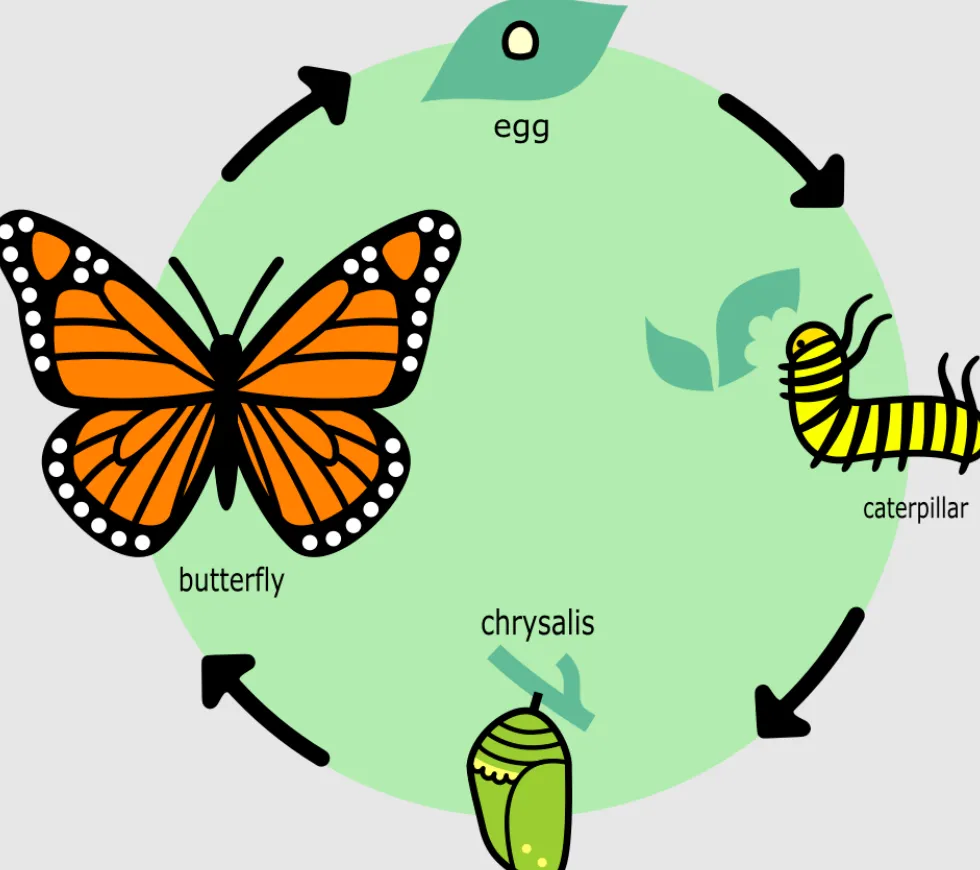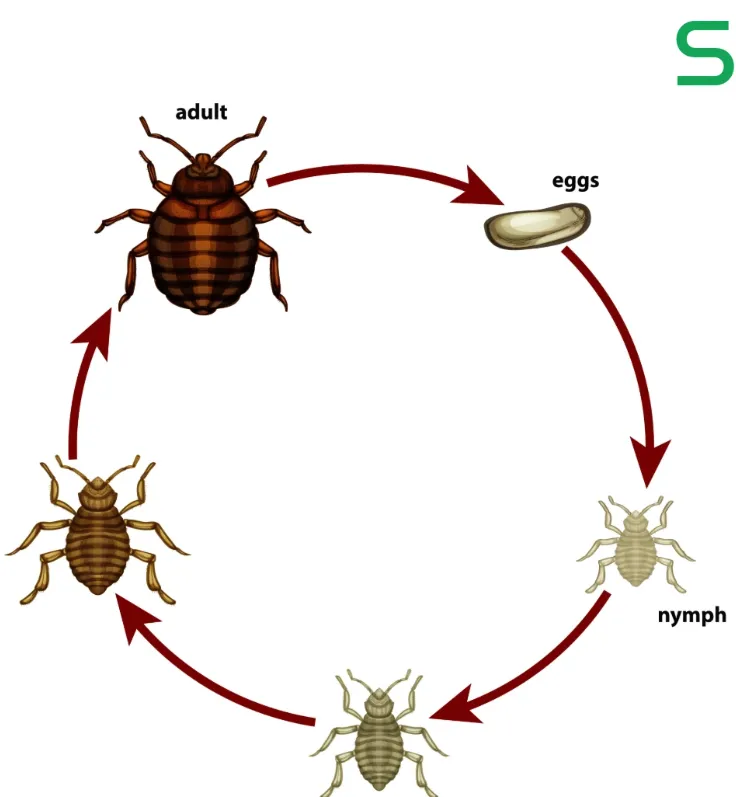
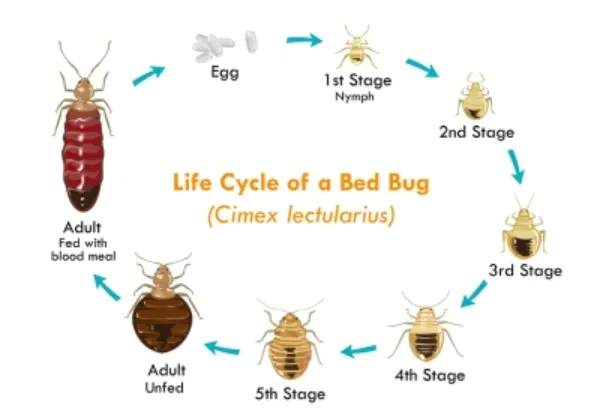
The life cycle of a bed bug is a simple but highly successful survival process that moves from egg to Nymph and then to adult bed bug. Unlike butterflies or moths, bed bugs do not have a pupal stage. They develop through incomplete metamorphosis, meaning young bed bugs look like smaller, paler versions of adults.
The common bed bug, scientifically known as Cimex lectularius, is a small, flat, reddish-brown, wingless insect that feeds on the blood of people and animals. Adults are usually about 5 mm long, while eggs are about 1 mm and white. Their flat bodies help them hide in mattress seams, bed frames, cracks, furniture joints, baseboards, and luggage folds.
A bed bug population can grow quickly when temperatures are warm and blood meals are available. Females lay eggs in hidden areas, nymphs hatch and feed, and each Nymph must take a blood meal before molting to the next stage. This makes early detection very important because eggs and young nymphs are easy to miss.
Q: How many stages are in the life cycle of a bed bug?
A: A bed bug has an egg, five nymph stages, and the adult stage.
Q: How long does a bed bug take to become an adult?
A: Under favorable indoor conditions, development may take about one month, but cooler temperatures or lack of food can slow it greatly.
Q: Do bed bugs spread disease?
A: Bed bugs are not known to spread diseases to people, but their bites can cause itching, sleep loss, allergic reactions, and stress.
Important Things That You Need To Know
Before studying the full life cycle of a bed bug, it is useful to understand the most searched related topics: bed bug, bed bug bite, what do bed bug bites look like, bed bug treatment, what does a bed bug look like, and bed bug eggs.
A bed bug is not a sign of poor hygiene. Bed bugs can appear in clean homes, hotels, dormitories, buses, trains, shelters, and apartments because they spread mainly by hiding in luggage, clothing, bedding, and secondhand furniture. Their flat bodies allow them to move unnoticed from one place to another.
A bed bug bite can look like a small red, itchy, swollen mark, but reactions vary. Some people show no visible signs, while others develop lines or clusters of itchy bumps. Because bed bug bites can resemble mosquito or flea bites, finding the insect, its eggs, shed skins, blood spots, or fecal marks is more reliable than relying on bites alone.
For bed bug treatment, the best approach is usually early inspection, careful cleaning, heat or professional pest control, and integrated pest management. Random pesticide use can be unsafe and ineffective if eggs, cracks, and hidden nymphs are missed. The EPA recommends IPM, a practical pest-management approach that reduces unnecessary pesticide exposure.
Quick Life Cycle Table
| Stage | What Happens | Key Fact |
| Egg | Females lay tiny white eggs in cracks, seams, or sheltered places | Eggs are about 1 mm long |
| 1st Nymph | A newly hatched nymph looks pale and tiny | Needs blood before molting |
| 2nd–4th Nymphs | Nymph grows larger after each blood meal | Each molt requires feeding |
| 5th Nymph | Final immature stage before adulthood | Becomes darker and larger |
| Adult | The reproductive stage begins | Adults can live for months and lay many eggs |
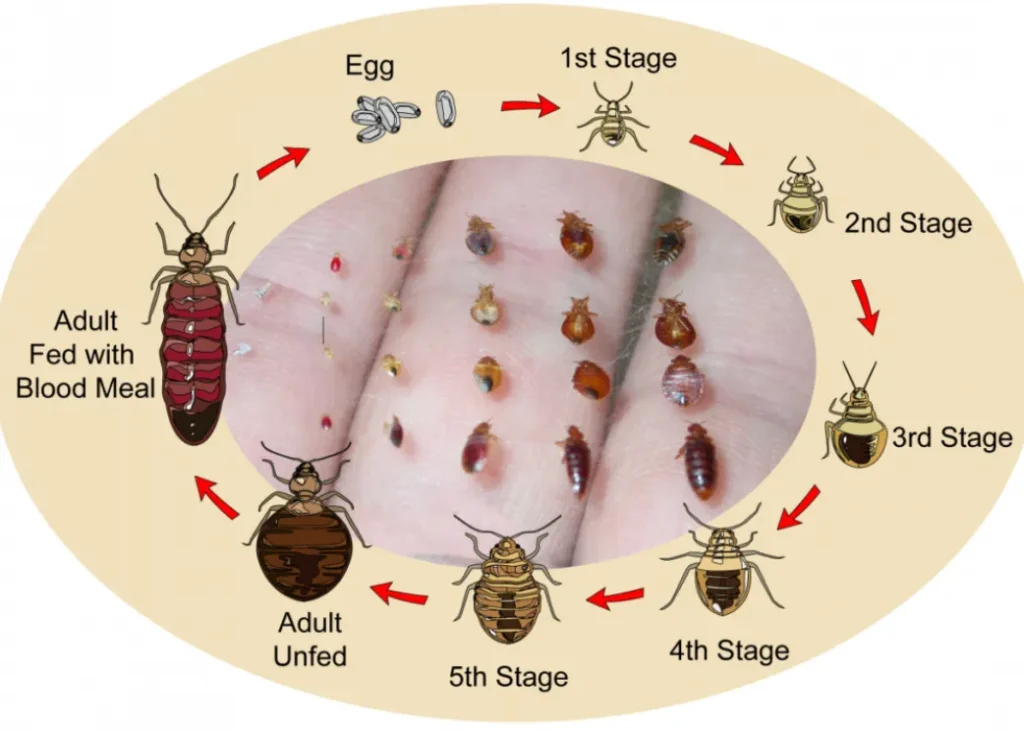
Bed bugs pass through five nymphal stages, and each nymphal stage requires a blood meal before molting to the next stage.
The History Of Their Scientific Naming, Evolution, and Their Origin
Scientific Name: Cimex lectularius
The common bed bug is scientifically named Cimex lectularius. The word Cimex comes from Latin and means “bug,” while lectularius refers to a bed or couch, which connects directly to the insect’s long association with human sleeping areas. Historical records show that bed bugs have been known to humans for centuries, and old European names often described their biting behavior, color, smell, or hiding places.
Evolutionary Background
Bed bugs belong to the family Cimicidae, a group of blood-feeding insects that feed on warm-blooded hosts such as humans, bats, and birds. The human-associated species Cimex lectularius is now widespread in temperate regions, while Cimex hemipterus is more common in tropical and subtropical regions.
Origin and Human Spread
Bed bugs spread with people because they are excellent hitchhikers. They do not fly or jump, but they move through luggage, furniture, bedding, clothing, and shared sleeping spaces. Their history follows human travel, housing, trade, and urban living.
Their Reproductive Process, Giving Birth And Rising Their Children
Bed Bugs Lay Eggs, They Do Not Give Live Birth
Bed bugs reproduce by laying eggs, not by giving live birth. A female lays eggs in protected locations, such as mattress seams, cracks, box springs, bed frames, or areas near where hosts sleep. Eggs are small, pale, and difficult to see without careful inspection.
Mating Happens Through Traumatic Insemination
Bed bugs have an unusual mating process called traumatic insemination. In this process, the male pierces the female’s body wall and releases sperm into her body cavity. This process can physically stress the female, and repeated mating may affect her egg production.
Egg Production Depends on Blood Meals
Female egg production depends heavily on access to blood meals. Some sources report that females may lay several eggs per day, while lifetime egg totals vary depending on temperature, feeding access, and survival conditions. The EPA notes that bed bugs may lay up to 500 eggs over a lifetime under favorable conditions, while Virginia’s bed bug biology guide reports lower average lifetime production in some studies.
No Parental Care
Bed bugs do not raise or protect their young. Once eggs are laid, the nymphs hatch and begin searching for a blood meal. Young nymphs are especially vulnerable because they are tiny, pale, and may die if they cannot find a host or suitable shelter.
Stages of the Life Cycle of a Bed Bug
Stage 1: Egg
The egg stage begins when an adult female lays tiny white eggs in hidden areas. Eggs are often placed where the bugs can remain close to a sleeping host. This may include mattress seams, bed frames, cracks in furniture, baseboards, or protected gaps near the bed.
Egg hatch time depends on temperature. CDC notes that eggs may hatch in about 4–12 days, while Ohio State University Extension reports a range of 6–17 days. These differences show why real-life infestations may develop faster in warm rooms and slower in cooler conditions.
Stage 2: Early Nymphs
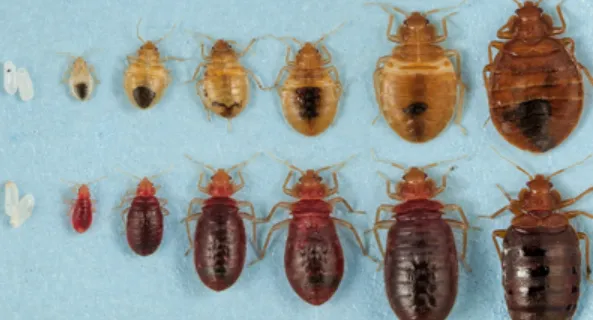
After hatching, the first-stage Nymph is small, pale, and difficult to see. It looks like a tiny version of the adult but is much lighter in color. Once it feeds, its body may appear reddish because the blood meal is visible through its body.
This stage is important because the Nymph cannot grow to the next stage without feeding. Each early Nymph must find a warm-blooded host, feed, hide again, digest, and molt.
Stage 3: Later Nymphs
The second, third, fourth, and fifth nymphal stages become gradually larger and darker. Each stage requires at least one blood meal before molting. Bed bugs shed their outer skin during molting, and these shed skins are a visible sign of an infestation.
Later nymphs are stronger than newly hatched nymphs, but they still depend on shelter, warmth, and blood meals. If food is scarce, development can slow down.
Stage 4: Adult Bed Bug
The adult stage is the reproductive stage. Adult bed bugs are flat, oval, reddish-brown, and wingless. After feeding, they become swollen, elongated, and darker red. Adults usually hide during the day and come out mostly at night to feed.
Adult females lay eggs after feeding and mating, continuing the population cycle. This is why a single fertilized female entering a room can start a new infestation if she finds regular blood meals.
Their Main Diet, Food Sources, And Collection Process Explained
Main Diet: Blood
The main diet of bed bugs is blood from warm-blooded hosts. Humans are the preferred hosts for common household infestations, but bed bugs may also feed on other mammals and birds when humans are unavailable.
Food Sources
Common food sources include:
- Humans sleep at night
- Pets, when human hosts are unavailable
- Birds or bats, especially in cases involving related Cimex species
- Warm-blooded animals in nearby nesting or roosting sites
Bed bugs are attracted to hosts through body warmth, carbon dioxide, and human odor cues. They usually stay close to sleeping areas because feeding is easier when the host is still.
Feeding Process
A bed bug uses piercing-sucking mouthparts to pierce the skin. During feeding, it injects saliva that contains substances that help it feed without being noticed immediately. CDC explains that many people do not notice bites at the time they occur; bite marks can appear later, from one to several days after feeding.
Feeding Time
Nymphs and adults generally take several minutes to complete a blood meal. CDC reports that nymphs and adults may take about 5–10 minutes to obtain a full blood meal, while Ohio State notes that a full-grown bed bug may feed for 10–15 minutes.
How long does the life cycle of a Bed Bug Live
The lifespan of a bed bug depends on temperature, food availability, life stage, humidity, pesticide exposure, and whether it lives in a home, hotel, dormitory, or laboratory setting.
- Egg stage: Eggs may hatch in a few days to over two weeks, depending on environmental conditions. Warmer indoor temperatures usually speed up hatching.
- Nymph stage: A nymph must feed before each molt. If blood meals are available, nymphs can develop steadily through five stages. If food is not available, development slows or stops.
- Egg to adult timing: Under favorable conditions, Virginia’s bed bug biology guide reports development from egg to reproductive adult at about 37 days, while Ohio State University Extension notes that development may be as fast as about 21 days at 86°F or as slow as 120 days at 65°F.
- Adult lifespan: CDC states that adult bed bugs may live 6–12 months and can survive long periods without feeding. Ohio State notes that the adult lifespan may reach 12–18 months in some conditions, while laboratory studies cited by Virginia report that well-fed adults live 99–300 days at room temperature.
- Survival without food: Bed bugs are resilient. EPA says they can live for several months without feeding, and Ohio State reports that late-instar nymphs and adults may survive 4–6 months without food under home-like study conditions.
- Real-life survival: In real homes, bed bugs face cleaning, changing temperatures, pest control, limited access to food, and physical disturbance. These factors may reduce survival compared with ideal laboratory conditions.
Life Cycle of a Bed Bug Lifespan in the Wild vs. in Captivity
Lifespan in Natural or Wild-Like Conditions
Bed bugs are not “wild animals” in the usual sense. Most common bed bugs live in human-made environments such as homes, apartments, hotels, dormitories, shelters, and transport systems. In wild-like settings, related species may live around bat roosts or bird nests.
In less stable environments, survival may be limited by temperature, access to hosts, predators, cleaning, relocation, and a lack of shelter. If blood meals are irregular, nymphs develop slowly and may die before becoming adults.
Lifespan in Captivity or Laboratory Conditions
In laboratories, bed bugs may live longer because temperature, humidity, feeding, and shelter can be controlled. Virginia’s bed bug biology guide reports that well-fed adults held at room temperature may live 99–300 days in laboratory settings.
Lifespan in Homes
Homes fall between wild and laboratory conditions. They provide warmth and hosts, but also cleaning, pesticide exposure, vacuuming, heat treatment, and disturbance. This makes lifespan variable and unpredictable.
Importance of the Life Cycle of a Bed Bug in this Ecosystem
A Small Part of Food Webs
Although bed bugs are human pests, they are still living organisms within broader ecological systems. In natural or semi-natural settings, small arthropods can become food for predators such as spiders, ants, and other insects. However, bed bugs are not considered sufficiently beneficial to justify protecting against infestations in homes.
Scientific and Medical Importance
The life cycle of a bed bug is important because it helps scientists, public health workers, and pest control professionals understand how infestations grow. Knowing that bed bugs have eggs, five nymph stages, and adults helps people target hidden life stages during treatment.
Indicator of Human Movement and Housing Conditions
Bed bugs are also linked with travel, secondhand furniture, dense housing, and shared sleeping spaces. Their presence does not prove a place is dirty, but it can reveal how easily pests move through human environments. CDC notes that bed bugs can be found in homes and hotels, and that cleanliness alone does not determine whether they are present.
Why Control Matters
Their ecological role is minor compared with their impact on human comfort, sleep, and mental stress. Therefore, the goal is not to conserve household bed bug populations, but to manage them safely and responsibly.
What to Do to Protect Them in Nature and Save the System for the Future
Because bed bugs are public-health pests, the better goal is to protect the ecosystem while reducing harmful infestations. This means using smart, careful, and low-risk control methods.
Use Integrated Pest Management
- Use IPM methods such as inspections, monitoring, heat treatment, vacuuming, sealing cracks, and professional treatment when needed.
- This reduces unnecessary pesticide exposure and protects indoor environmental quality.
Avoid Random Pesticide Use
- Do not overuse chemicals without correct identification.
- Misuse may harm people, pets, beneficial insects, and indoor air quality.
Protect Natural Predators Outdoors
- Avoid unnecessary broad-spectrum insecticide use outdoors.
- Healthy ecosystems support natural predators such as spiders and other arthropods.
Reduce Waste and Secondhand Spread
- Inspect used furniture before bringing it indoors.
- Avoid dumping infested items without properly labeling or wrapping them.
Support Public Awareness
- Teach people that bed bugs are hitchhiking pests, not a hygiene failure.
- Early reporting and treatment can reduce the spread and misuse of pesticides.
Fun & Interesting Facts About the Life Cycle of a Bed Bug
- Bed bugs do not fly or jump. They crawl and hide in tight spaces.
- A bed bug egg is tiny, about 1 mm, making it hard to spot during early infestation.
- Young nymphs look like small adults, not caterpillars or larvae.
- Bed bugs need blood before each molt, so feeding is essential for their development.
- They can survive months without feeding, especially older nymphs and adults.
- Bed bug bites do not look the same on everyone. Some people show no marks, while others develop itchy red bumps.
- They prefer hiding near sleeping areas, often within a short distance of the host.
- Shed skins are a major clue because bed bugs molt several times before adulthood.
- Clean homes can still get bed bugs because they travel through luggage, clothes, furniture, and shared spaces.
- The adult bed bug becomes swollen and darker after feeding, making it look different from an unfed adult.
Frequently Asked Questions FAQs
Q: What does a bed bug look like?
A: An adult bed bug is small, flat, oval, reddish-brown, and wingless. It is usually around 5 mm long and becomes swollen and darker red after feeding.
Q: What do bed bug bites look like?
A: Bed bug bites may look like small red, swollen, itchy marks. They may appear randomly or in a line, but some people show no visible reaction at all. Bite appearance alone cannot confirm an infestation.
Q: How many eggs can a bed bug lay?
A: Egg numbers vary by feeding and temperature. Some references report 200–500 eggs in a lifetime under favorable conditions, while other studies report lower average lifetime production.
Q: How long do bed bug eggs take to hatch?
A: Eggs may hatch in about 4–12 days according to the CDC, while the Ohio State University Extension reports 6–17 days, depending on conditions.
Q: What is the best bed bug treatment?
A: The best bed bug treatment usually combines inspection, monitoring, cleaning, heat or professional control, and integrated pest management. Professional help is often needed for established infestations.
Conclusion
The life cycle of a bed bug explains why this tiny insect is so difficult to control. From nearly invisible bed bug eggs to five active nymph stages and long-living adults, every stage is designed for survival in hidden spaces near sleeping hosts. Bed bugs do not spread disease, but their bites can cause itching, sleep loss, anxiety, and discomfort. Their ability to hide, survive without food, and reproduce after blood meals makes early detection essential.
Understanding what a bed bug looks like, how bed bug bites appear, where eggs are laid, and how nymphs develop helps people respond more quickly and safely. The best approach is not panic or random chemical use, but careful inspection, prevention, and professional bed bug treatment when needed. A well-informed response protects both human health and the surrounding environment.
Also Read: horse fly larva life cycle