Unlike plants, a mushroom does not make food from sunlight. It belongs to the kingdom Fungi, and it feeds by breaking down organic matter outside its body and absorbing the dissolved nutrients through tiny fungal threads called hyphae. This is why mushrooms are so important in forests, farms, gardens, and natural ecosystems. They help recycle dead material and return nutrients to the soil.
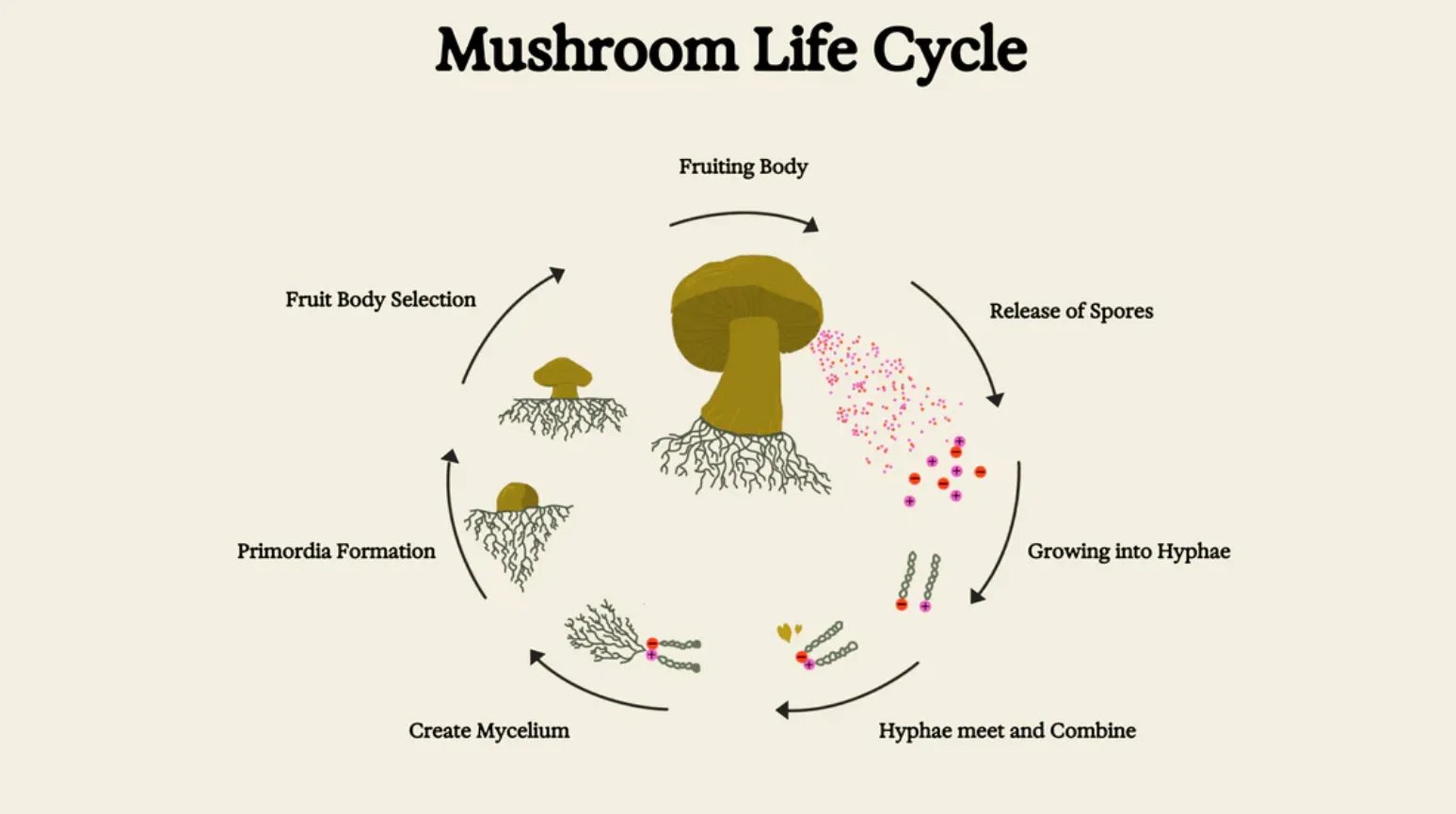
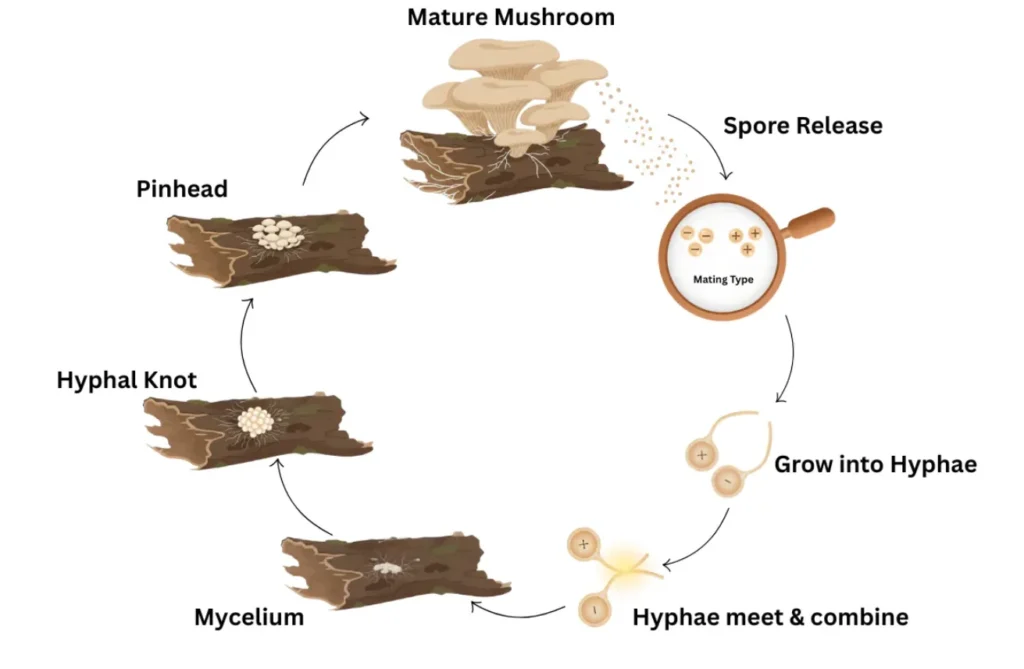
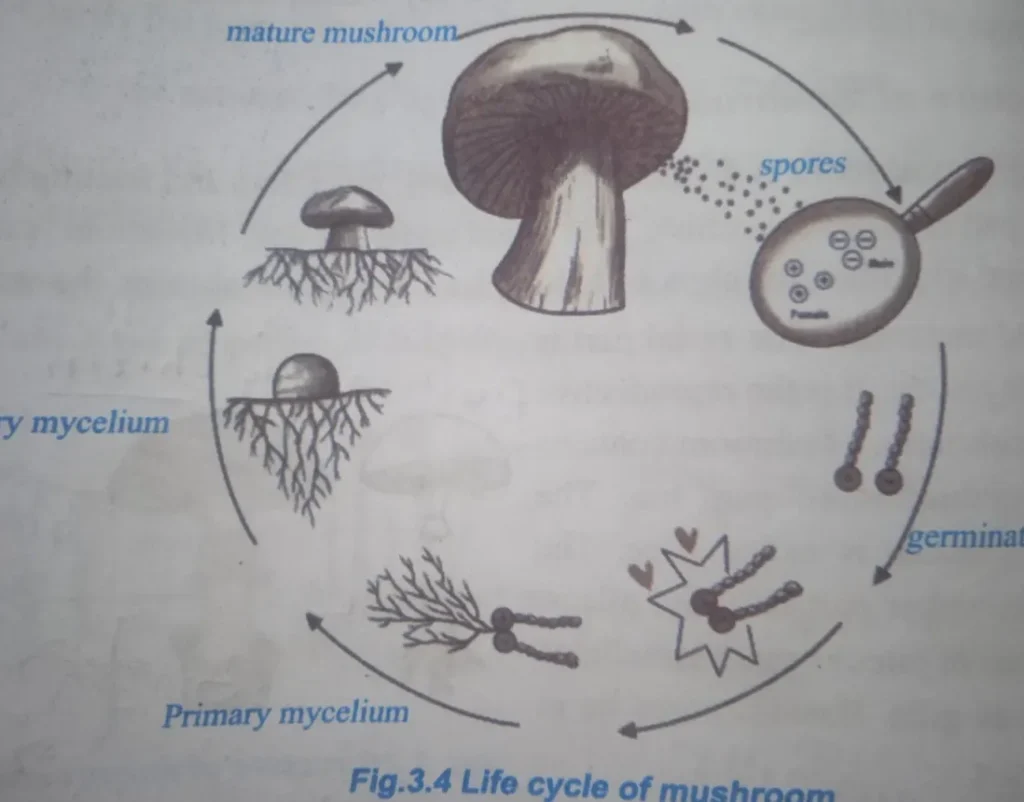
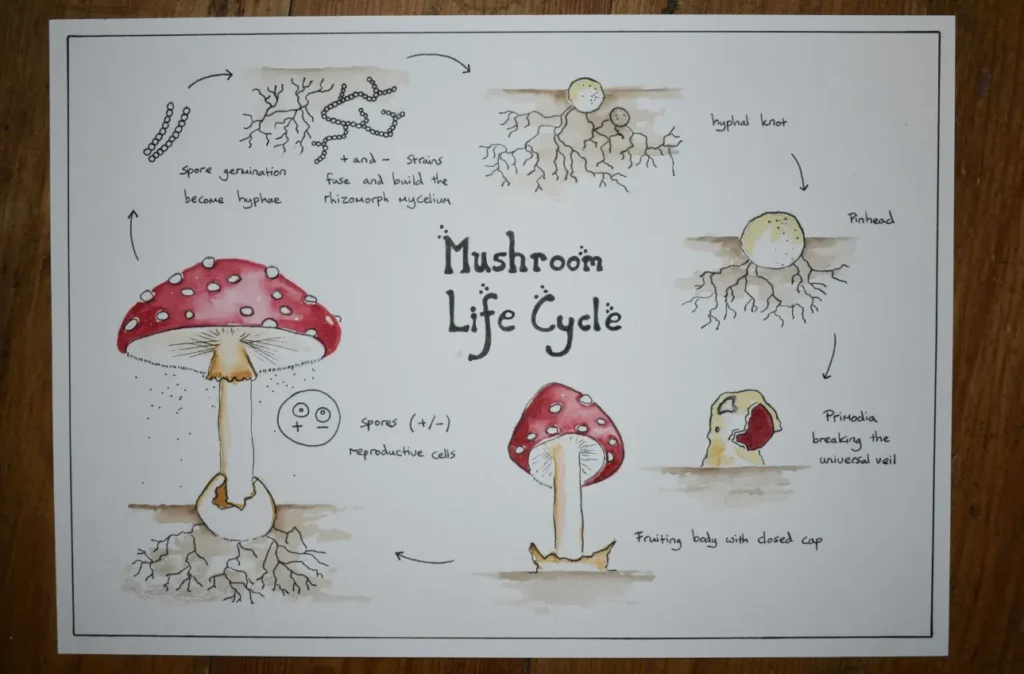
The life cycle usually begins with spores, then progresses to hyphae, mycelium, primordia, and finally to the fruiting body we call a mushroom. When the mushroom matures, it releases new spores, and the cycle starts again. Cornell Small Farms explains this wild cycle as moving between mushroom, spore, and mycelium, with the mushroom’s main role being spore production.
Q: What is the mushroom life cycle?
A: The mushroom life cycle is the growth process from spore to hyphae, then mycelium, pinning, fruiting body, and back to spore release.
Q: Is a mushroom a plant?
A: No. A mushroom is a fungus, not a plant. It does not use photosynthesis. It absorbs nutrients from organic matter.
Q: What is the most important part of a mushroom?
A: The hidden mycelium is often the most important part because it feeds, spreads, survives, and later produces the mushroom fruiting body.
Quick Life Cycle Table
| Stage | What Happens | Simple Nature Clue |
| 1. Spore | Tiny reproductive cells leave a mature mushroom. | Like dust carried by wind, rain, or insects. |
| 2. Germination | A spore lands on a suitable moist surface and begins to grow. | Needs moisture, food, and the right temperature. |
| 3. Hyphae | Thin, thread-like fungal strands appear. | These threads search for food. |
| 4. Mycelium | Many hyphae join into a living network. | The hidden body of the fungus. |
| 5. Primordia / Pins | Small baby mushroom forms begin to appear. | Tiny bumps on soil, wood, or compost. |
| 6. Fruiting Body | The visible mushroom grows with a cap, stem, gills, or pores. | This is the mushroom we usually see. |
| 7. Spore Release | A mature mushroom releases spores to begin the cycle again. | The next generation spreads into nature. |
Important Things That You Need To Know
Many people search for mushroom topics for different reasons, so it helps to separate biology from food trends and wellness products. The mushroom life cycle concerns the growth of fungi in nature. Still, related terms like lion’s mane mushroom, shiitake mushroom, enoki mushroom, and turkey tail mushroom often appear because they are popular edible or supplement mushrooms.
Shiitake mushrooms and enoki mushrooms are usually considered food mushrooms. Lion’s mane mushroom and turkey tail mushroom are often found in supplement products, while mushroom coffee and mushroom gummies are modern consumer products. These products are not the same as studying how a mushroom grows in soil, wood, or compost. They are connected by the word ‘mushroom,’ but their purposes differ.
It is also important to be careful with health claims. UConn Extension notes that the FDA does not approve medicinal mushroom supplements as treatments for cancer or other medical conditions, and people with mushroom allergies should avoid them.
The FDA has also warned consumers about Amanita muscaria and certain related compounds used in some mushroom edibles, stating that these substances do not meet food safety standards and may be harmful.
The phrase “mellow mushroom” is often searched too, but it is more closely associated with food branding and restaurant searches than with fungal biology. This article focuses on the natural life cycle of mushrooms.
The History of Their Scientific Naming
The scientific naming of mushrooms belongs to taxonomy, the system scientists use to name and classify living organisms. Mushrooms are placed in the kingdom Fungi, but each species has its own scientific name.
A common example is Agaricus bisporus, the cultivated button mushroom, in the cremini and portobello forms. GBIF lists Agaricus bisporus as a species and notes that it is among the most widely consumed mushrooms in the world.
Important points about mushroom naming:
- Binomial names consist of two parts: the genus and the species. In Agaricus bisporus, Agaricus is the genus and bisporus is the species name.
- Mushroom names often changed as scientists learned more about fungal structure, spores, and genetics.
- The common mushroom had a complex naming history. GBIF notes that it was first described as a variety of Agaricus campestris, later transferred to Psalliota, and eventually given its current name, Agaricus bisporus, by Emil Imbach in 1946.
- The word bisporus refers to its two-spored basidia, which helped separate it from similar mushrooms.
Scientific naming matters because common names can be confusing. One mushroom may have many local names, but a scientific name gives researchers one clearer way to identify it.
Their Evolution And Their Origin
The origin of mushrooms is tied to the much older story of fungi. Fungi are ancient organisms, and mushrooms are only one visible form within this large kingdom. Long before humans grew mushrooms for food, fungal networks were already working through soil, wood, and ancient ecosystems.
Modern fungi likely played a major role in helping early land plants survive. Kew’s Grow Wild project notes that around 500 million years ago, the first land plants likely depended on symbiotic relationships with fungi to get nutrients from difficult early land environments.
This relationship still exists today. Many plants form symbiotic relationships with mycorrhizal fungi, which help them take up water and nutrients. In return, plants provide sugars made through photosynthesis. This partnership shows why fungi are not just background organisms. They are part of the foundation of life on land.
Mushroom-forming fungi became more visible later in the fossil record. A major fossil discovery, Gondwanagaricites magnificus, was described from the Lower Cretaceous Crato Formation in Brazil. The study reported it as the oldest fossil mushroom known at the time and placed it at about 113–120 million years old.
The reason mushroom fossils are rare is simple: mushrooms are soft and decay quickly. A cap and stem may last only a short time before insects, bacteria, weather, and other fungi break them down. This makes fossil preservation difficult.
The evolution of the mushroom life cycle gave fungi a smart survival plan. The hidden mycelium can live and feed for long periods, while the short-lived fruiting body appears when conditions are right. This lets the fungus save energy, wait for moisture, and release spores when the chance of survival is better.
Their main food and its collection process
Mushrooms do not eat the way animals eat. They do not chew, swallow, or digest food inside a stomach. Instead, the mycelium grows through a food source and releases enzymes into the surrounding material.
These enzymes break large organic compounds into smaller pieces. After that, the fungal threads absorb the dissolved nutrients through their cell walls. Britannica explains that fungi feed by secreting enzymes into the surface they grow on, then absorbing the digested food through hyphal walls.
Main food sources include:
- Dead wood: Many mushrooms break down fallen branches, logs, and tree stumps.
- Leaf litter: Forest mushrooms help decompose old leaves and return nutrients to the soil.
- Compost and manure-rich soil: Some mushrooms grow well in nutrient-heavy organic matter.
- Plant roots: Mycorrhizal mushrooms connect with living plant roots and trade nutrients.
- Dead plants and animals: Some fungi help break down remains and recycle minerals.
The collection process happens through hyphae. These tiny threads spread into cracks, fibers, soil particles, and decaying material. The more the mycelium spreads, the more surface area it has for absorbing nutrients.
This is why mycelium can be powerful even when it looks fragile. A single strand is tiny, but a full network can explore a large area. It can move through wood, soil, compost, or bark while searching for usable food.
When the mycelium has enough stored energy, and the weather becomes favorable, it can shift from feeding mode into reproduction mode. Then it forms pins, which grow into the mushroom fruiting body.
Their life cycle and ability to survive in nature
Spore release and spreading
The mushroom life cycle begins when mature mushrooms release spores. These spores may fall close to the parent mushroom or travel by wind, water, animals, or insects. Spores are tiny, light, and built for spreading.
Germination and hyphae growth
When a spore lands in the right place, it may germinate. It needs moisture, oxygen, food, and the right temperature. From that spore, a thin thread called a hypha grows. Many hyphae join and form mycelium.
Mycelium as the survival body
The mycelium is the fungus’s main survival system. It can hide underground, inside wood, or within compost. This hidden growth helps the fungus avoid drying sunlight, animal damage, and sudden weather changes.
Pinning and fruiting body formation
When conditions are right, the mycelium forms tiny knots called primordia or pins. These pins grow into the visible mushroom. Cornell Small Farms describes the mushroom’s main role as producing spores that help the organism continue its life cycle.
Survival in harsh conditions
Mushrooms survive by waiting. If the weather is too dry or cold, the mycelium may stay hidden. When the rain, humidity, and temperature become suitable, mushrooms may appear quickly. That is why mushrooms often seem to “pop up” after rain.
Their Reproductive Process and raising their children
Mushrooms do not raise their young as animals do. They have no nest, no milk, no parental care, and no direct protection for offspring. Instead, they rely on mass spore production, wide dispersal, and the strength of the environment.
Their reproductive process works through these steps:
- Spore production: The mature mushroom forms spores on gills, pores, teeth, or other spore-bearing surfaces.
- Spore release: Spores are released into the air or carried away by rain splash, insects, animals, or wind.
- Landing on substrate: A spore must land on a suitable food source such as damp wood, soil, compost, or plant matter.
- Germination: If conditions are right, the spore germinates and forms hyphae.
- Hyphal fusion: In many mushroom-forming fungi, compatible hyphae from different spores may fuse. This creates a stronger reproductive mycelium.
- Mycelial growth: The new mycelium spreads and feeds. This hidden stage may last much longer than the mushroom itself.
- Fruiting: When the mycelium has enough energy and the environment gives the right signals, it forms a fruiting body.
- Cycle repeats: The fruiting body releases spores, starting the next generation.
So, in a natural sense, the “children” of mushrooms are spores. The parent mushroom does not protect them. It releases many spores because only a small number will land in the right place and survive.
This strategy may seem risky, but it works. By producing huge numbers of spores, mushrooms increase the chance that at least some will find moisture, food, and space to grow.
The importance of them in this Ecosystem
Mushrooms recycle nutrients
Mushrooms are natural recyclers. They help break down dead leaves, fallen wood, old roots, and other organic matter. Without fungi, forests and grasslands would collect layers of dead material much faster.
Britannica notes that fungi, along with bacteria, help break down organic matter and release carbon, oxygen, nitrogen, and phosphorus back into the soil and atmosphere.
They support plant life.
Many mushrooms form mycorrhizal relationships with plant roots. These fungi help plants take up water and minerals. In return, plants give the fungi sugars. This quiet exchange supports forests, gardens, and wild plant communities.
They build healthy soil.
As mushrooms break down material, they help create richer soil. Their mycelium also helps bind soil particles, which can support soil structure. Healthy soil holds water better and gives plants a better place to grow.
They feed wildlife
Mushrooms are food for insects, slugs, rodents, deer, squirrels, and many other animals. Some animals also spread spores after eating mushrooms, helping fungi reach new places.
They support human life.
Humans use mushrooms as food, research materials, fermentation aids, and partners in soil health. Edible mushrooms such as shiitake, enoki, and button mushrooms are part of diets around the world.
What to do to protect them in nature and save the system for the future
Protecting mushrooms means protecting the habitats where mycelium, spores, plants, insects, and soil organisms live together.
- Do not destroy wild mushroom patches.
- Pick carefully, and avoid digging up the underground mycelium.
- Leave some mushrooms behind.
- Mature mushrooms release spores, so removing every fruiting body can reduce local reproduction.
- Protect old trees and fallen logs.
- Dead wood is not waste in nature. It is food and shelter for many fungi.
- Avoid unnecessary chemical use.
- Heavy use of pesticides, fungicides, and herbicides can harm fungi and soil life.
- Keep forest floors natural.
- Leaf litter, bark, and old branches help fungi feed and survive.
- Never eat unknown wild mushrooms.
- Some poisonous mushrooms look similar to edible ones. Trained experts should do the identification.
- Support native plant growth.
- Native plants often have long relationships with local fungi.
- Protect wetlands, forests, and grasslands.
- Different mushrooms need different habitats. Saving habitat saves fungal diversity.
- Use compost wisely.
- Compost supports decomposer fungi and helps return organic matter to soil.
- Teach people that fungi matter.
- Many people ignore mushrooms because they are small or short-lived. Education helps people see their real value.
- Buy mushroom products responsibly.
- For mushroom gummies, extracts, and supplements, choose tested products and avoid unsafe or misleading claims.
- Respect rare fungi.
- Some mushrooms fruit only under special conditions. Taking photos instead of picking can help protect them.
Frequently Asked Questions (FAQs)
Q1: What are the main stages of the mushroom life cycle?
A: The main stages are spore, germination, hyphae, mycelium, primordia, fruiting body, and spore release.
Q2: How long does the mushroom life cycle take?
A: It depends on the species and environment. Some mushrooms fruit within weeks, while some mycelial networks may live for years before producing visible mushrooms.
Q3: What is mycelium in the mushroom life cycle?
A: Mycelium is the hidden network of fungal threads. It feeds, grows, stores energy, and produces mushrooms when conditions are right.
Q4: Are mushroom spores the same as seeds?
A: Spores are not true seeds, but they work similarly. They help the fungus spread and start new growth.
Q5: Why do mushrooms appear after rain?
A: Rain raises moisture levels. Many mushrooms need moisture and humidity to form fruiting bodies, so they often appear after wet weather.
Q6: Do mushrooms need sunlight to grow?
A: Mushrooms do not need sunlight for food because they do not photosynthesize. However, some species use light as a signal for fruiting direction and growth.
Q7: Is mushroom coffee part of the mushroom life cycle?
A: No. Mushroom coffee is a drink product that may contain mushroom extracts or powders. It is not a biological stage of mushroom growth.
Q8: Are lion’s mane mushrooms and turkey tail mushrooms real mushrooms?
A: Yes, lion’s mane mushroom and turkey tail mushroom are real fungi. They are often discussed in the food and supplement markets, but their natural life cycles still follow fungal growth patterns involving spores and mycelium.
Conclusion
The mushroom life cycle is a simple-looking process with deep natural value. It begins with a tiny spore, grows into hidden hyphae, forms a strong mycelium, and finally produces the visible mushroom fruiting body. That mushroom then releases new spores, and the cycle continues.
What makes mushrooms special is how much work they do out of sight. They break down dead material, feed soil, support plants, and help ecosystems stay balanced. A mushroom on the forest floor is not just a random growth after rain. It is the visible sign of a living network beneath the surface.
From shiitake mushrooms and enoki mushrooms to wild forest fungi, mushrooms show how nature wastes almost nothing. They turn decay into new life. Protecting them means protecting soil, forests, food chains, and the future health of natural systems.
Also Read: life cycle of the bees