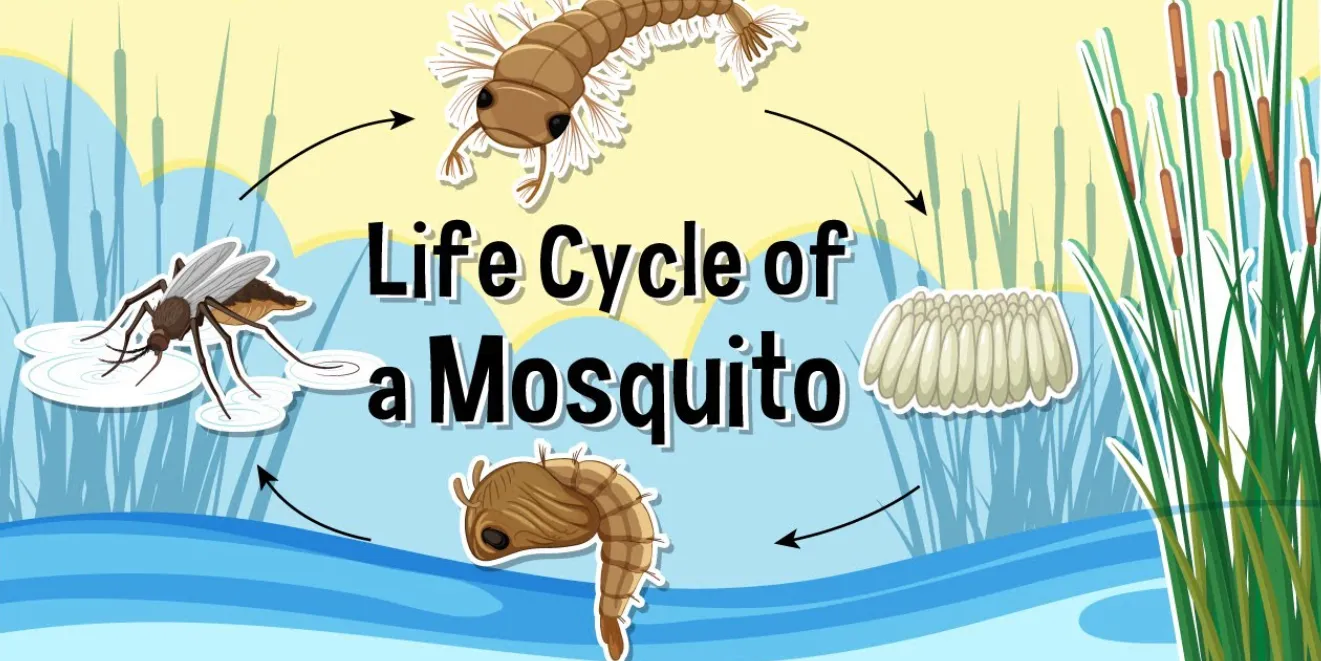
The life cycle of a mosquito explains how a mosquito develops from a tiny egg into a flying adult insect. Mosquitoes belong to the insect family Culicidae and pass through four main life stages: egg, larva, pupa, and adult. The first three stages need water, while the adult stage is the flying stage.
This is why even a small amount of standing water in a cup, tire, flower pot, gutter, or bird bath can become a breeding ground for mosquitoes. The CDC notes that some mosquito life cycles can be completed in about 8–10 days, while others may take 10–14 days, depending on species, temperature, food supply, and water conditions.
Mosquitoes are often known for mosquito bites, but only female mosquitoes bite humans or animals. They need blood mainly to produce eggs. Male mosquitoes feed mostly on nectar and plant sugars. Although mosquitoes can spread diseases, they also play roles in food chains as larvae and adults. Fish, dragonfly nymphs, bats, birds, spiders, and other insects may feed on mosquitoes at different stages.
Q: How many stages are in the mosquito life cycle?
A: The mosquito life cycle has four stages: egg, larva, pupa, and adult.
Q: How long does the life cycle of a mosquito take?
A: In warm conditions, some mosquitoes can develop from egg to adult in about 8–14 days, but timing changes by species and environment.
Q: Why do mosquitoes need water?
A: Mosquitoes need water because their eggs hatch in water, and the larva and pupa stages live in water before becoming adults.
Quick Life Cycle Table
| Stage | Where It Happens | Main Activity | Approx. Time |
| Egg | On or near water | Waits for water and warmth | A few days to months |
| Larva | In water | Feeds, grows, molts | Around 5 days or more |
| Pupa | In water | Transforms into an adult | About 2–3 days |
| Adult | Air, plants, homes, outdoors | Flies feed, mate, and lay eggs | Days to weeks or longer |
Important Things That You Need To Know
Understanding mosquitoes, mosquito bites, mosquito repellents, mosquito control, and mosquito larvae helps you manage mosquitoes without harming the entire ecosystem. The most effective prevention starts with water management because mosquitoes cannot complete their early life stages without standing water. Emptying or covering water containers is one of the simplest ways to control mosquitoes.
For personal protection, the CDC recommends using EPA-registered mosquito repellent products with active ingredients such as DEET, picaridin, IR3535, oil of lemon eucalyptus, PMD, or 2-undecanone, following the product label. These repellents are used to reduce mosquito bites, especially in areas where mosquito-borne diseases are a concern.
Another important tool is mosquito dunks, which usually contain Bti (Bacillus thuringiensis israelensis). Bti is used in standing water to kill developing mosquito larvae before they become flying adults. The EPA explains that Bti can be applied to water-holding places such as flower pots, tires, bird baths, and similar containers where larvae are found.
The phrase “mosquito hawk” is commonly used in different contexts to refer to insects like crane flies or dragonflies. Dragonflies are real mosquito predators, especially around ponds and wetlands, but crane flies are often mistaken for giant mosquitoes. So, when people search for “mosquito hawk,” they may be looking for natural mosquito predators rather than an actual mosquito species.
The History of Their Scientific Naming, Evolution, and Origin
Scientific Naming of Mosquitoes
The common word mosquito comes from Spanish and Portuguese roots meaning “little fly.” Scientifically, mosquitoes are placed in the family Culicidae under the order Diptera, which includes true flies. Important mosquito groups include Aedes, Anopheles, and Culex, but each species has its own scientific name, such as Aedes aegypti or Anopheles gambiae. Britannica describes mosquitoes as insects of the family Culicidae, with thousands of recognized species worldwide.
Evolution and Ancient Origin
Mosquito evolution dates back to prehistoric times. Fossil and molecular evidence suggest that mosquitoes have ancient roots, with known fossils dating back to the Cretaceous period. A 2025 fossil report described a mosquito larva preserved in about 99-million-year-old amber, giving scientists rare evidence of early mosquito development.
Why Their Origin Matters
Their long evolutionary history shows that mosquitoes have strongly adapted to water-based development, plant-feeding, and, in many female species, blood-feeding. This adaptation helped them survive in forests, wetlands, grasslands, cities, farms, and homes across the world.
Their Reproductive Process, Giving Birth, And Rising Their Children
Mosquitoes Do Not Give Birth Like Mammals
Mosquitoes do not give birth to live babies. They reproduce by laying eggs. After mating, a female mosquito looks for a suitable place to lay eggs. Depending on the species, eggs may be laid on the surface of water, near the waterline, on damp soil, or inside containers that can later fill with water.
Why Female Mosquitoes Take Blood
Female mosquitoes often need a blood meal to develop eggs. Blood provides protein and nutrients for egg production. This is the main reason female mosquitoes bite humans, birds, mammals, reptiles, or other animals. Male mosquitoes do not take blood meals; they feed on plant nectar and other sugar sources.
Egg Laying and Early Growth
A female mosquito can lay many eggs at one time. Some Culex mosquitoes lay eggs in floating rafts, while Aedes mosquitoes often place eggs on container walls above the waterline. CDC notes that some Aedes eggs can survive drying for months and hatch when water covers them.
No Parental Care
Mosquitoes do not raise their young. Once eggs are laid, the female does not feed or protect the larvae. Young mosquitoes survive by feeding on water, avoiding predators, and developing quickly into pupae and adults.
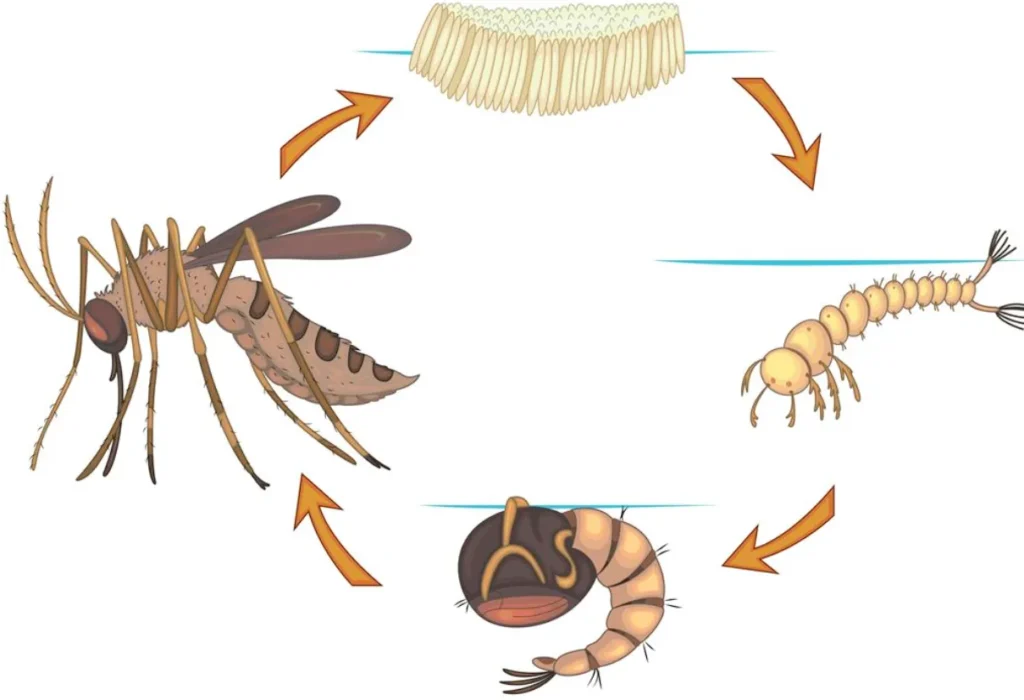
Stages of the Mosquito Life Cycle
Egg Stage
The egg stage is the beginning of the mosquito life cycle. Female mosquitoes lay eggs in or near water because moisture is necessary for hatching. Some species lay single eggs, while others lay egg rafts. In warm weather, eggs may hatch quickly, but some eggs can remain dormant until water reaches them.
This stage is important for mosquito control because removing standing water stops eggs from hatching. A tiny water source can support mosquito breeding, so prevention should include gutters, buckets, old tires, plant saucers, and uncovered water containers.
Larva Stage
The larva stage is the active feeding stage. Mosquito larvae live in water and are often called wigglers because they move with a wiggling motion. Larvae feed on organic particles, microorganisms, algae, and tiny material in the water. Many larvae come to the surface to breathe air.
Larvae grow by molting several times. This stage can be short in warm, nutrient-rich water. Since larvae cannot fly away, this is one of the best stages for safe, targeted control using water removal or larval control methods such as Bti.
Pupa Stage
The pupa stage is the stage of transformation. Mosquito pupae live in water but do not feed. They are sometimes called tumblers because of their movement. Inside the pupa, the mosquito changes from a water-living form into an adult flying insect. EPA notes that pupae are the stage immediately preceding adult emergence.
This stage usually lasts only a short time. CDC materials show that pupae may develop into adult flying mosquitoes in about 2–3 days, depending on conditions.
Adult Stage
The adult mosquito emerges from the pupa at the water’s surface. After its body hardens and its wings dry, it can fly. Adult mosquitoes feed, mate, rest, and continue the life cycle. Males mostly feed on nectar, while females may feed on nectar and, in many species, blood.
Adult females search for blood when they need nutrients for eggs. After feeding, they lay eggs in a suitable habitat, and the cycle begins again.
Their main diet, food sources, and collection process are explained
Mosquito diet changes by life stage. The larva stage feeds in water, while the adult stage feeds mostly from plants, with many females also taking blood meals for reproduction.
Larvae collect food by filtering or scraping tiny particles from water. They may consume algae, bacteria, protozoa, and decaying organic matter. This makes the larval stage part of the aquatic nutrient cycle. Clean water, polluted water, tree holes, containers, ponds, ditches, and wetlands can support different mosquito species.
Adult male mosquitoes feed on nectar and plant sugars. Adult female mosquitoes also use sugar as a source of energy. Blood is not their everyday “food” in the same way nectar is; females mainly use blood to produce eggs. This is why female mosquitoes are linked with mosquito bites.
The collection process is highly specialized. A female mosquito uses sensory cues such as body heat, odor, moisture, and carbon dioxide to locate a host. After landing, she uses her long mouthpart, called a proboscis, to pierce skin and take blood. This feeding process is also why some mosquito species can transmit pathogens.
How long does a mosquito’s life cycle last
The lifespan of a mosquito depends on species, temperature, humidity, food, predators, and habitat. There is no single lifespan for all mosquitoes, but the full life cycle can be very fast in warm conditions.
- Egg-to-adult timing: Some mosquitoes can develop from egg to adult in about 8–10 days, while Anopheles species often take about 10–14 days under suitable conditions.
- Egg survival: Some eggs hatch quickly when covered with water, but certain Aedes eggs can survive dry conditions for months before hatching when water returns.
- Larva stage: Larvae may develop into pupae in as few as 5 days, especially when water is warm and food is available.
- Pupa stage: Pupae usually become adults in about 2–3 days. They do not feed during this stage.
- Adult stage: Adult mosquitoes may live from several days to several weeks. Some sources note that adult mosquitoes can live for weeks to months, depending on environmental conditions.
- Male mosquitoes: Males usually have shorter lives and spend most of their adult time feeding on nectar and mating.
- Female mosquitoes: Females often live longer than males because they must find blood meals, produce eggs, and lay eggs. In some conditions, females may lay eggs more than once.
- Cold-weather effect: In colder climates, some mosquitoes survive winter as eggs, larvae, or adults, depending on the species.
- Hot-weather effect: Warm weather can speed development, but extreme heat or dry conditions may reduce survival if water sources dry up.
- Predator pressure: Fish, dragonfly nymphs, aquatic insects, birds, bats, and spiders can reduce mosquito survival at different stages.
Cycle Life of Mosquito Lifespan in the Wild vs. in Captivity
Lifespan in the Wild
In the wild, mosquitoes face many risks. Eggs may dry out, larvae may be eaten by fish or aquatic insects, pupae may fail to emerge, and adults may be killed by weather, predators, or human control methods. Wild mosquitoes also depend on natural breeding sites such as puddles, tree holes, marshes, ponds, rice fields, drains, and containers.
Lifespan in Captivity
In captivity or laboratory conditions, mosquitoes may live longer because temperature, humidity, food, and water are controlled. Scientists rear mosquitoes in labs to study development, behavior, disease transmission, and control methods. In these conditions, mosquitoes may avoid many natural predators and environmental dangers.
Main Difference
The main difference is survival pressure. In the wild, mosquitoes must survive unstable water, predators, heat, rain, and control efforts. In captivity, they receive controlled food and habitat. This is why laboratory lifespan data can be useful for research but may not always match natural outdoor survival.
Importance of the Cycle Life of Mosquitoes in this Ecosystem
Food Source for Other Animals
Mosquitoes are part of many food chains. Fish, aquatic insects, amphibians, and other small water predators can eat mosquito larvae. Spiders, bats, birds, dragonflies, and other insects may eat adult mosquitoes. Their role as prey connects aquatic and land-based food webs.
Part of Aquatic Nutrient Cycling
During the larval stage, mosquitoes feed on tiny organic matter in water. This helps move nutrients through aquatic systems. While mosquitoes are not the only insects doing this job, their larvae can be common in certain water habitats.
Pollination and Plant Feeding
Adult mosquitoes, especially males, feed on nectar and plant sugars. Some adult mosquitoes may help with small-scale pollination while feeding. Their pollination role is not as well known as that of bees or butterflies, but nectar feeding still connects mosquitoes to plants.
Public Health Importance
Mosquitoes are also important because some species transmit diseases. Britannica notes that less than 10 percent of mosquito species are vectors of human disease, but those species can be highly important for public health.
What to do to protect them in nature and save the system for the future
Protect Wetlands, But Manage Standing Water Near Homes
- Natural wetlands support many species, not only mosquitoes.
- Protecting wetlands helps fish, birds, frogs, dragonflies, and aquatic plants.
- Around homes, remove artificial standing water to prevent mosquito outbreaks.
Use Targeted Mosquito Control
- Use mosquito control methods that target larvae rather than spraying everything.
- Bti can target mosquito larvae in standing water and is used in many mosquito-control programs.
- Always follow label directions when using any control product.
Encourage Natural Predators
- Protect dragonflies, frogs, fish, bats, birds, and spiders.
- Avoid destroying every insect habitat.
- A balanced ecosystem can naturally reduce mosquito numbers.
Reduce Pollution in Water Bodies
- Polluted drains and stagnant wastewater can support mosquito breeding.
- Cleaner water systems help improve ecosystem health.
- Community drainage and waste management reduce mosquito problems.
Use Repellent Without Harming Nature
- For personal safety, use EPA-registered mosquito repellent correctly.
- Avoid overusing insecticides outdoors.
- Choose prevention first: screens, nets, long sleeves, and water removal.
Fun & Interesting Facts About the Life Cycle of a Mosquito
- Mosquitoes are true flies because they belong to the order Diptera.
- The word mosquito means “little fly” in Spanish and Portuguese.
- Only female mosquitoes bite humans or animals in species that need blood for egg production.
- Male mosquitoes usually feed on nectar and plant sugars.
- Mosquito larvae are called wigglers because of their movement in water.
- Mosquito pupae are called tumblers because they tumble when disturbed.
- Mosquitoes do not need a large pond to breed; some species can breed in very small water containers.
- Some Aedes eggs can survive for months in dry conditions before hatching.
- Dragonflies are natural mosquito predators and are sometimes linked with the nickname mosquito hawk.
- Mosquitoes have existed for millions of years, with fossils showing ancient mosquito relatives from the Cretaceous period.
Frequently Asked Questions (FAQs)
Q: What is the life cycle of a mosquito?
A: The life cycle of a mosquito is the full development process from egg to larva, pupa, and adult. The first three stages happen in water, and the adult stage is the flying stage.
Q: How long does a mosquito take to become an adult?
A: In warm conditions, some mosquitoes can become adults in about 8–14 days, depending on species and environment.
Q: Where do mosquitoes lay eggs?
A: Mosquitoes lay eggs in or near water. Some lay eggs on water surfaces, while others place eggs on damp surfaces or container walls where water may later rise.
Q: Do all mosquitoes bite humans?
A: No. Male mosquitoes do not bite. Only female mosquitoes of many species bite because they need blood to develop eggs.
Q: What is the best way to control mosquito larvae?
A: The best first step is removing standing water. For water that cannot be removed, larvicidal control, such as Bti mosquito dunks, may help control mosquito larvae when used according to label directions.
Conclusion
The life cycle of a mosquito is a simple yet powerful natural process built around water. From egg to larva, pupa, and adult, mosquitoes can complete development quickly when conditions are warm and wet. This is why standing water plays such a major role in mosquito growth and household mosquito problems. At the same time, mosquitoes are not only pests; they are also part of food chains, aquatic systems, and natural predator-prey relationships.
A smart understanding of the mosquito life cycle helps people control mosquitoes more safely. Instead of relying only on sprays, the best approach is to remove standing water, protect the body from mosquito bites, use proper mosquito repellent, and apply targeted larval control when needed. By carefully managing mosquitoes, we can protect public health while respecting the balance of nature.
Also Read: moss life cycle