The malaria life cycle is one of the most important topics to understand if you want to understand how malaria spreads, why it causes recurrent fever, and why prompt treatment matters. A virus or a bacterium does not cause malaria. It is caused by tiny parasites called Plasmodium, which usually enter the human body through the bite of an infected female Anopheles mosquito.
Once inside the body, the parasite first travels to the liver, grows silently, and then enters red blood cells. This blood stage is when most malaria symptoms appear, including fever, chills, headache, sweating, fatigue, nausea, and body aches. In severe cases, malaria can affect the brain, kidneys, lungs, and blood, which is why it can become life-threatening without fast care.
According to the latest WHO data, malaria remains a major global disease, with an estimated 282 million cases and 610,000 deaths in 2024. The good news is that malaria is preventable, testable, and treatable, and newer tools such as approved malaria vaccine options are helping protect children in high-risk regions.
Q: What is malaria?
A: Malaria is a mosquito-borne disease caused by Plasmodium parasites. It spreads mainly through infected female Anopheles mosquitoes.
Q: Is malaria contagious?
A: No. Malaria usually does not spread from person to person like the flu or COVID-19. It mainly spreads when a mosquito bites an infected person and then bites another person.
Q: What are the common symptoms of malaria?
A: Common symptoms of malaria include fever, chills, headache, muscle pain, tiredness, nausea, vomiting, and diarrhea. Severe malaria can cause confusion, seizures, breathing trouble, coma, or death.
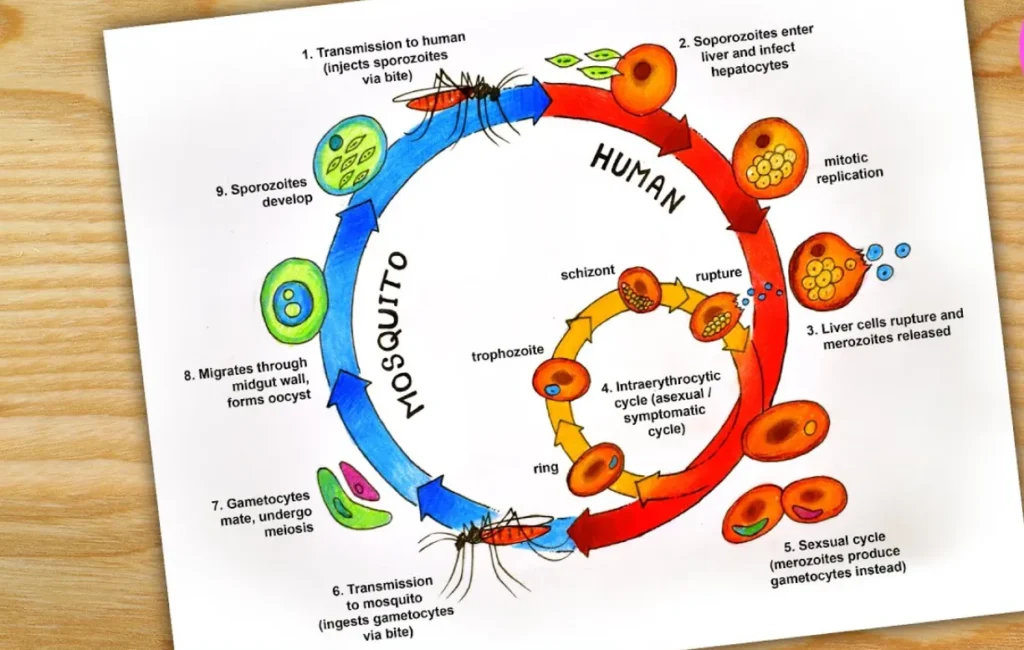
Quick Life Cycle Table
| Stage | Where It Happens | What Happens |
| 1. Mosquito bite | Human skin | An infected Anopheles mosquito injects sporozoites into the blood. |
| 2. Liver stage | Human liver | Parasites enter liver cells and multiply quietly. |
| 3. Blood stage | Red blood cells | Parasites infect red blood cells and break them, causing fever and chills. |
| 4. Gametocyte stage | Human blood | Some parasites become male and female forms called gametocytes. |
| 5. Mosquito feeding | Mosquito gut | A mosquito bites an infected person and ingests gametocytes. |
| 6. Mosquito stage | Mosquito body | Parasites reproduce inside the mosquito and move to its salivary glands. |
| 7. New infection | Another human | The mosquito bites again, initiating a new cycle of malaria. |
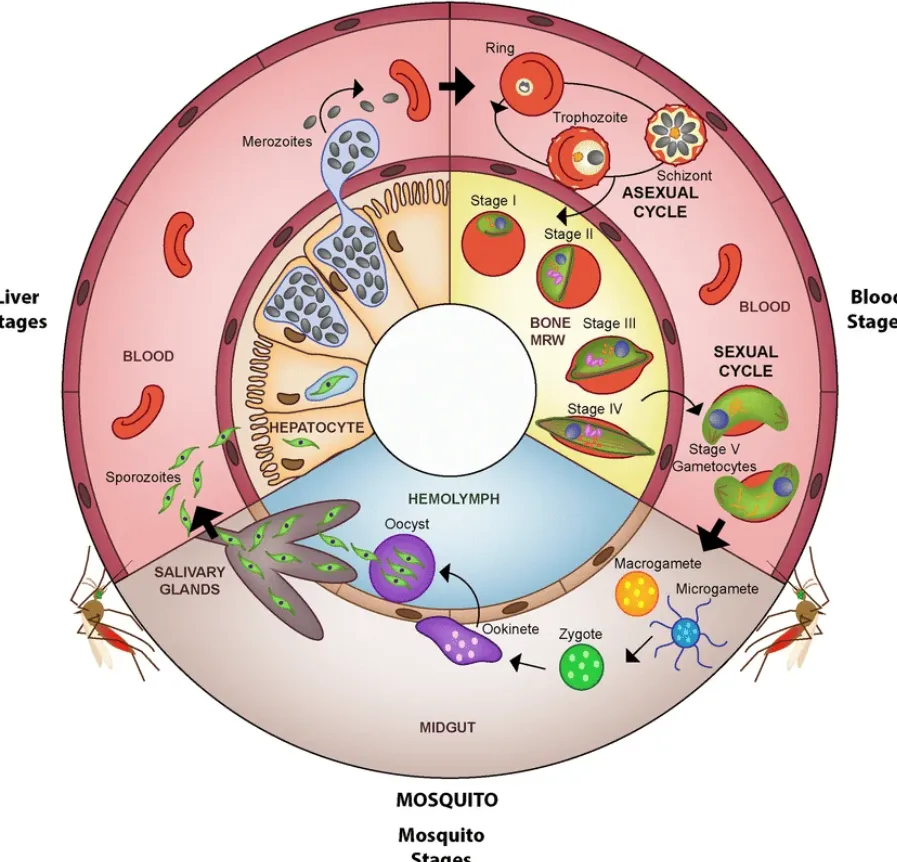
The full malaria life cycle needs two living hosts: a human and a female Anopheles mosquito. This is why malaria control must target both the parasite inside humans and the mosquito that carries it. The CDC describes this cycle as progressing through the liver, blood, and mosquito stages, with gametocytes enabling continued transmission.
Important Things That You Need To Know
Understanding the malaria life cycle also helps answer common questions about malaria symptoms, malaria treatment, and prevention. Malaria is dangerous because the parasite hides and multiplies before many people realize they are sick.
The first important point is that malaria is not spread by casual contact. You do not usually get it by hugging, sharing food, sitting near someone, or breathing the same air. The main route is the bite of an infected mosquito. In rare cases, malaria may spread through blood transfusion, organ transplant, shared needles, or from mother to baby during pregnancy, but these are not the usual ways.
The second point is that early symptoms of malaria can look like the flu. Fever, chills, headache, sweating, body pain, and weakness are common. This makes testing especially important after travel to a malaria-risk area.
The third point is that malaria medication depends on the parasite type, severity, patient age, pregnancy status, and local drug resistance. Doctors may use artemisinin-based combination therapy for many uncomplicated cases, while severe malaria needs urgent hospital care.
The fourth point is the malaria vaccine. WHO now recommends two malaria vaccines, RTS, S and R21, for children in areas where P. falciparum malaria is a major risk. These vaccines do not replace bed nets, mosquito control, testing, or treatment, but they add another layer of protection.
So, when people ask what malaria is, the simple answer is this: malaria is a preventable and treatable parasite disease, but it can become deadly when diagnosis or treatment is delayed.
The History of Their Scientific Naming
The scientific naming of malaria parasites is tied to the history of medicine, microscopy, and tropical disease research.
- The word malaria comes from the old Italian words meaning “bad air.” Long ago, people believed the disease came from foul air around swamps and marshes.
- Later, scientists discovered that malaria was not caused by air, but by a blood parasite.
- The parasite belongs to the genus Plasmodium. This name refers to the parasite’s unusual form and movement inside host cells.
- Several Plasmodium species can infect humans. The most important include Plasmodium falciparum, Plasmodium vivax, Plasmodium ovale, Plasmodium malariae, and Plasmodium knowlesi.
- P. falciparum is the deadliest human malaria parasite because it can multiply quickly and block tiny blood vessels.
- P. vivax and P. ovale can form sleeping liver stages called hypnozoites, which may wake up later and cause relapse.
Today, scientists use the name Plasmodium to refer to the malaria-causing parasites that infect humans, birds, reptiles, and other animals. The CDC notes that there are many named Plasmodium species, though only a smaller group commonly infects humans.
Their Evolution And Their Origin
The origin of malaria parasites goes back millions of years. These parasites did not appear suddenly in humans. They evolved slowly over long periods through relationships with insects, animals, and blood-feeding mosquitoes.
The wider Plasmodium group infects many vertebrates, including birds, reptiles, rodents, primates, and humans. This tells scientists that malaria parasites are ancient and highly adaptable. Their survival depends on a complex pattern: they must live in one host, enter a mosquito, reproduce there, and then infect another host.
Human malaria likely developed through parasite shifts from animal hosts to humans over time. Some malaria parasites are strongly linked to primates, suggesting that parts of malaria evolution occurred alongside the evolution of apes and humans. Plasmodium falciparum, the most dangerous species, is closely related to malaria parasites found in African great apes.
The immune system also shapes the parasite’s evolution. Humans develop immune defenses, and the parasite develops ways to avoid them. This back-and-forth struggle is one reason malaria remains hard to eliminate.
Mosquito evolution also matters. The female Anopheles mosquito became an ideal carrier because it feeds on blood to develop eggs. When it bites an infected human, it can pick up parasite forms called gametocytes. When it bites again later, it may pass the parasite to another person.
This long evolutionary history explains why the malaria life cycle is so efficient. The parasite uses the liver for silent growth, red blood cells for rapid multiplication, and mosquitoes for sexual reproduction and movement between hosts.
Their main food and its collection process
Malaria parasites do not eat like animals. Their “food” comes from the cells they invade. In humans, the most important feeding stage happens inside red blood cells.
After leaving the liver, the parasite enters red blood cells and begins to digest hemoglobin, the oxygen-carrying protein in red blood cells. This provides the parasite with the nutrients it needs to grow and divide.
Key points about their feeding process:
- They invade red blood cells:
- The parasite enters a red blood cell and creates a safe space around itself.
- They digest hemoglobin:
- Inside the cell, the parasite breaks down hemoglobin and uses its components for growth.
- They release waste pigment:
- The digestion process produces a dark waste material called hemozoin, also known as malaria pigment.
- They multiply inside the cell:
- The parasite grows and divides into many new forms called merozoites.
- They burst the cell:
- The infected red blood cell breaks open, releasing new parasites into the blood.
- They repeat the cycle:
- These new parasites infect more red blood cells, causing waves of fever, chills, and sweating.
This feeding process is one reason malaria causes anemia. When many red blood cells are destroyed, the body loses healthy oxygen-carrying cells. That can lead to weakness, fatigue, dizziness, and serious illness.
In mosquitoes, the parasite does not feed on red blood cells in the same way. Instead, it uses the mosquito gut as a place for sexual reproduction and development. The mosquito is not just a vector; it is an essential part of the parasite’s life cycle.
Their life cycle and ability to survive in nature
1. Survival Inside Humans
The malaria life cycle begins when an infected female Anopheles mosquito injects sporozoites into human skin. These tiny parasite forms quickly move into the bloodstream and travel to the liver.
Inside the liver, the parasite multiplies quietly. This stage may not cause symptoms at first. After the liver stage, parasites enter the blood and attack red blood cells. This is when fever and other malaria symptoms usually begin.
2. Survival Inside Blood Cells
The blood stage is the most harmful stage for humans. The parasite hides inside red blood cells, digests hemoglobin, multiplies, and bursts the cells open.
This repeated bursting causes fever cycles, chills, sweating, anemia, and weakness. In severe cases, infected blood cells can block small blood vessels, especially in P. falciparum malaria.
3. Survival Inside Mosquitoes
Some blood parasites become gametocytes. When another mosquito bites the infected person, it takes in these forms.
Inside the mosquito gut, male and female parasite forms join. The parasite then develops, moves through the mosquito’s body, and finally reaches the salivary glands.
4. Survival Strategy in Nature
The parasite survives by using two hosts. It uses humans for asexual multiplication and mosquitoes for sexual reproduction. This two-host strategy makes malaria difficult to stop because control must break the cycle in more than one place.
Their Reproductive Process and raising their children
Malaria parasites do not raise children like mammals, birds, or insects. They reproduce by producing many new parasite forms. Their “offspring” are microscopic stages that continue the infection.
Important points about their reproductive process:
- Asexual reproduction in the liver:
- After entering the liver, sporozoites multiply inside liver cells. One parasite can produce many new forms.
- Asexual reproduction in red blood cells:
- After liver-stage parasites enter the blood, they invade red blood cells and multiply again. This creates many merozoites, which infect more red blood cells.
- Repeated multiplication causes illness:
- Each round of red blood cell invasion and rupture can trigger fever, chills, and sweating.
- Sexual forms develop in human blood:
- Some parasites become male and female gametocytes. These forms do not cause the same damage as rapidly multiplying blood forms, but they are essential for spreading malaria to mosquitoes.
- Sexual reproduction happens in mosquitoes:
- When a mosquito drinks infected blood, gametocytes enter its gut. Male and female forms join, creating new parasite stages.
- New infectious forms reach mosquito saliva:
- The parasite eventually becomes sporozoites and moves to the mosquito’s salivary glands.
- The next bite starts the cycle again:
- When that mosquito bites another person, the parasite enters a new human host.
So, malaria parasites do not care for their offspring. Their survival depends on producing large numbers of new forms and moving between humans and mosquitoes at the right time.
The importance of them in this Ecosystem
Parasites Are Part of Natural Systems
Even harmful parasites exist within ecosystems. Plasmodium parasites are part of food webs, host-parasite relationships, and mosquito biology. In wild animals, malaria-like parasites may influence population health, survival, and evolution.
However, this does not mean human malaria parasites should be protected. Malaria kills people, especially young children, pregnant women, and people with weaker immunity. The public health goal is to safely and effectively stop human-to-human transmission of malaria.
Mosquitoes Have Ecological Roles
Mosquitoes are often seen only as pests, but some mosquito species also serve as food for fish, birds, bats, dragonflies, and other insects. Male mosquitoes may feed on nectar and take part in plant pollination in some settings.
Still, disease-carrying mosquitoes create serious health risks. Control programs usually focus on reducing mosquito contact with humans, killing larvae in breeding sites, using treated nets, and improving housing and drainage.
Why Studying Malaria Matters
The importance of malaria parasites lies mainly in their role in scientific understanding. Studying them helps improve malaria medication, vaccines, diagnosis, mosquito control, and public health planning.
By learning how the parasite survives, scientists can find weak points in the malaria life cycle. These weak points help develop better drugs, vaccines, and prevention methods.
What to do to protect them in nature and save the system for the future
Because malaria parasites harm humans, the right goal is not to protect the parasite. The better goal is to protect human health, preserve useful parts of nature, and reduce malaria without damaging the entire Ecosystem.
- Use insecticide-treated bed nets carefully:
- Bed nets help stop mosquito bites at night, especially in malaria-risk areas.
- Remove standing water near homes:
- Mosquitoes breed in stagnant water. Clean drains, buckets, tires, and water containers.
- Improve housing protection:
- Window screens, closed doors, sealed wall gaps, and better roofing can reduce mosquito entry.
- Support safe mosquito control:
- Larval control, indoor spraying, and community programs should be done with proper guidance.
- Protect wetlands responsibly:
- Not every wetland should be destroyed. Some wetlands support birds, fish, and plants. The goal is smart water management, not careless habitat damage.
- Use malaria testing before treatment when possible:
- Proper diagnosis helps avoid wrong medication and slows drug resistance.
- Complete prescribed malaria medication:
- Stopping treatment early can allow parasites to survive and may support resistance.
- Support vaccine programs:
- In high-risk areas, malaria vaccine rollout can reduce severe disease in children.
- Watch for drug and insecticide resistance:
- Resistance can weaken malaria control. Health systems need monitoring and updated strategies.
- Educate communities:
- People should know what malaria is, how it spreads, and when to seek medical help.
Saving the future means reducing malaria while keeping ecosystems balanced. Human safety comes first, but nature should be managed with care.
Frequently Asked Questions (FAQs)
Q1: What is the malaria life cycle?
A: The malaria life cycle is the journey of the parasite between humans and mosquitoes. It begins when an infected mosquito bites a person, continues in the liver and red blood cells, and is then transmitted back to mosquitoes when they bite an infected person.
Q2: What are the first symptoms of malaria?
A: Early malaria symptoms often include fever, chills, headache, sweating, tiredness, muscle pain, nausea, vomiting, or diarrhea. These symptoms can mimic the flu symptoms, so testing is important.
Q3: Is malaria contagious?
A: No, malaria is not usually contagious through touch, air, food, or casual contact. It mainly spreads through bites from infected Anopheles mosquitoes.
Q4: What is the most dangerous malaria parasite?
A: Plasmodium falciparum is usually the most dangerous human malaria parasite. It can cause severe malaria, brain involvement, organ failure, and death if not treated quickly.
Q5: Can malaria come back after treatment?
A: Yes, some types, such as P. vivax and P. ovale, can hide in the liver as sleeping forms called hypnozoites. They may cause relapse later if not treated with the right medicine.
Q6: What is the best malaria treatment?
A: The best malaria treatment depends on the parasite species, location, drug resistance, patient age, pregnancy status, and severity. Many uncomplicated P. falciparum cases are treated with artemisinin-based combination therapy, while severe malaria needs urgent medical care.
Q7: Is there a malaria vaccine?
A: Yes. WHO recommends RTS, S and R21 malaria vaccines for children in areas where P. falciparum malaria is a serious public health risk. Vaccines help reduce illness, but should be used with nets, testing, treatment, and mosquito control.
Q8: Can malaria be prevented?
A: Yes. Prevention includes sleeping under treated nets, avoiding mosquito bites, removing stagnant water, using preventive medicine when advised for travel, supporting vaccine programs in eligible areas, and getting tested quickly when symptoms appear.
Conclusion
The malaria life cycle shows why this disease is both dangerous and difficult to control. The parasite does not stay in one place. It moves from mosquito to human, from blood to liver, from liver back to blood, and then into another mosquito. Each stage helps it survive.
For people, the most important lesson is simple: malaria can be prevented, tested, and treated, but delays can be deadly. Fever after mosquito exposure or travel to a malaria-risk area should never be ignored. Early testing and correct malaria medication can save lives.
At the same time, tools such as treated bed nets, safer mosquito control, better housing, cleaner surroundings, and the malaria vaccine are changing the fight against malaria. The goal is not to protect the parasite. The goal is to protect people, reduce suffering, and manage nature wisely so future generations live with less malaria risk.
Also Read: life cycle of the ladybird