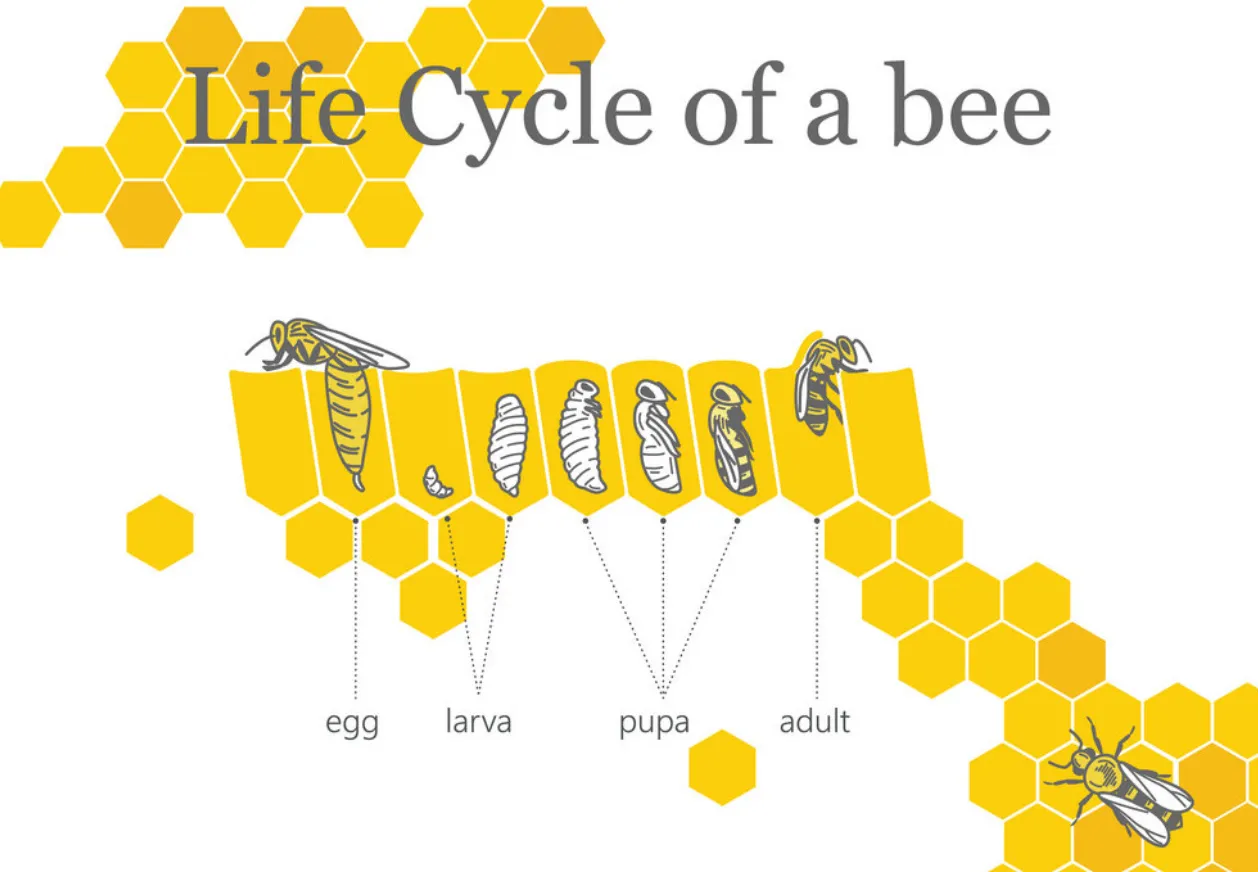
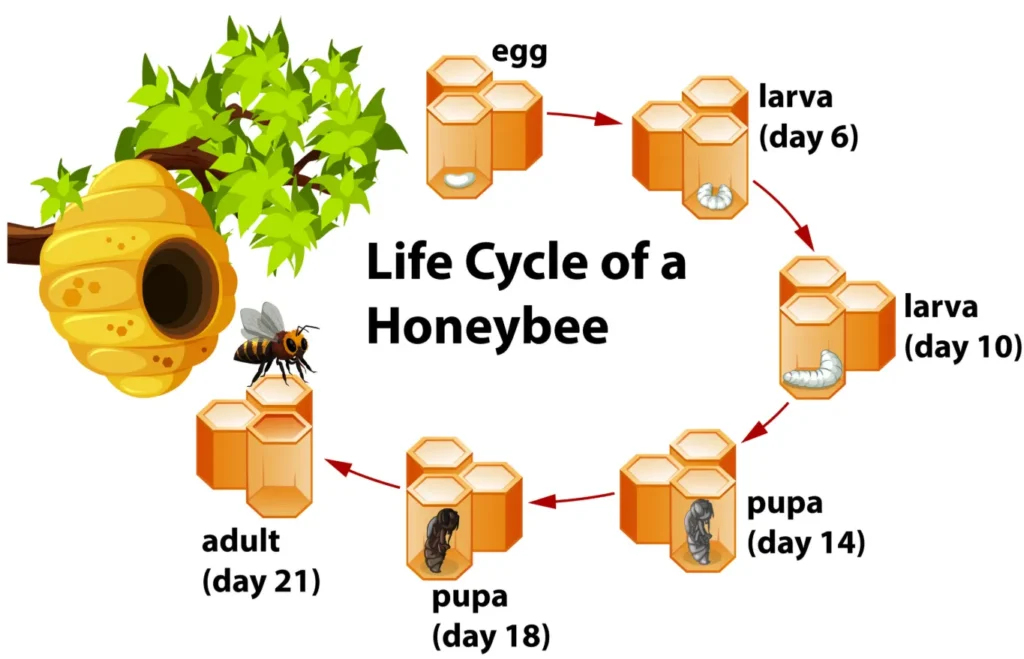
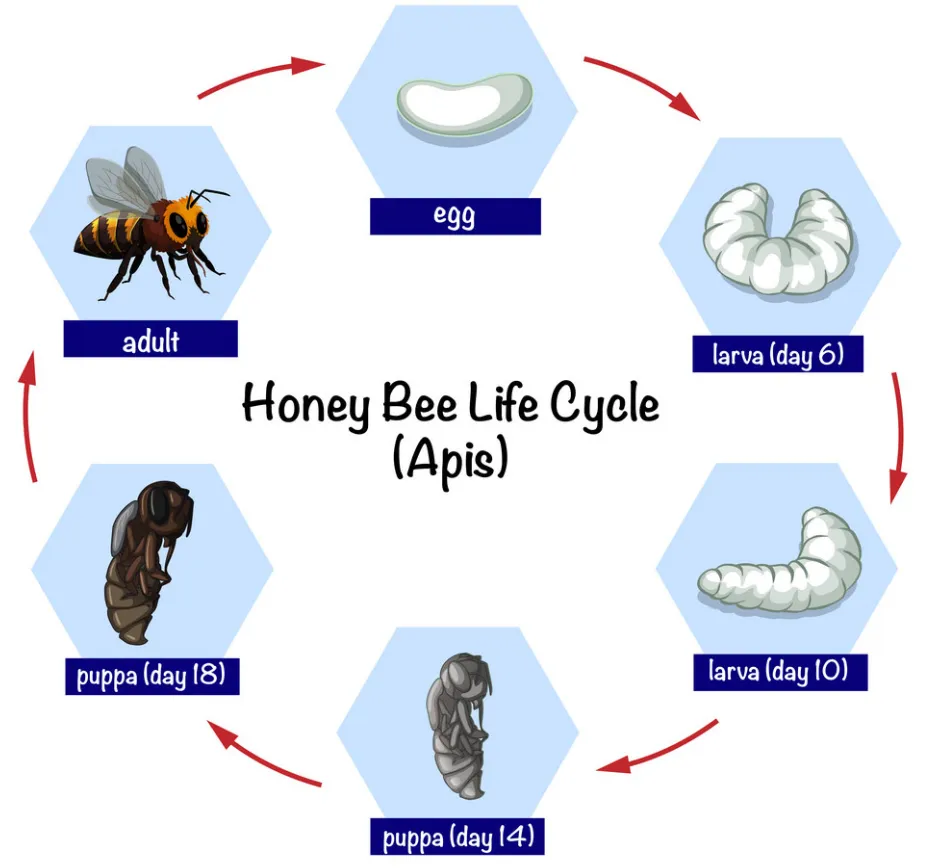
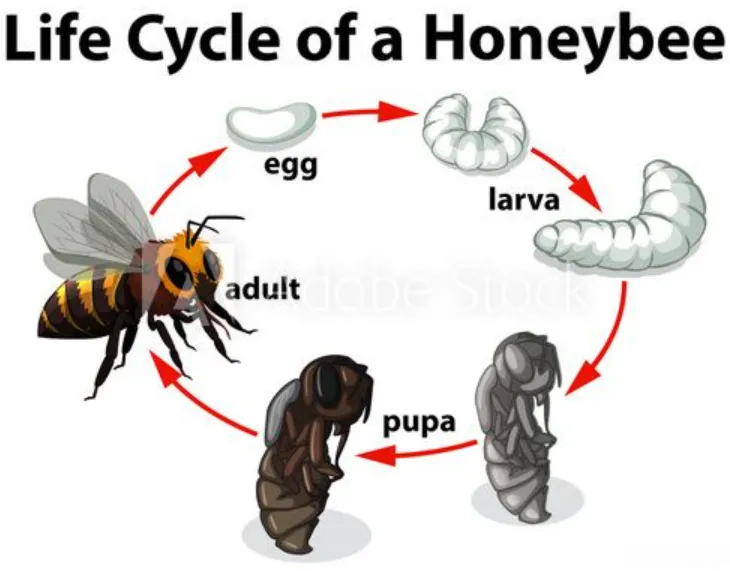
The life cycle of the bees is one of the most important natural processes on Earth. Bees begin life as tiny eggs, grow into larvae, transform inside sealed cells as pupae, and finally emerge as adult bees with specific roles inside or outside the colony. This process, called complete metamorphosis, is shared by many insects. Still, bees make it especially fascinating because their lives are deeply connected to teamwork, food collection, reproduction, pollination, and ecosystem balance. The four main stages are egg, larva, pupa, and adult.
When people search for the life cycle of the bees, they usually want to know how long bees live, how baby bees grow, how queens lay eggs, and why bees matter so much to humans. Honey bees are especially well known, but the world also includes many types of bees, including bumble bees, stingless bees, sweat bees, leafcutter bees, and carpenter bees. Each species has its own nesting style, but the basic life cycle pattern is similar.
Bees are not just honey makers. They are powerful pollinators that help flowering plants reproduce. About 75 percent of global food crops depend on pollinators to some extent, underscoring the close ties between bees, food, farming, and biodiversity.
Quick Answers: Most Common Questions
Q: What are the four stages in the life cycle of the bees?
A: The four stages are egg, larva, pupa, and adult. This complete transformation is known as complete metamorphosis.
Q: How long does it take a honey bee to become an adult?
A: In honey bees, a queen usually develops in about 16 days, a worker bee in about 21 days, and a drone in about 24 days.
Q: Why are bees so important in nature?
A: Bees move pollen from flower to flower, helping plants produce fruits, seeds, and new plants. This supports food crops, wildflowers, birds, insects, and many other parts of the Ecosystem.
Quick Life Cycle Table
| Bee life stage | What happens | Approximate time in honey bees | Why it matters |
| Egg | The queen lays a tiny egg in a wax cell | Around 3 days | This is the beginning of every bee’s life |
| Larva | The egg hatches into a soft, white larva fed by nurse bees | Around 5 to 6 days for queens, longer for workers and drones | Nutrition decides growth, strength, and caste development |
| Pupa | The larva changes inside a capped cell | Around 7 to 15 days, depending on caste | Wings, legs, eyes, and adult body parts form |
| Adult Queen | A fertile female emerges | About 16 days total | Lays eggs and keeps the colony going |
| Adult Worker | A female worker emerges | About 21 days total | Cleans, feeds brood, builds comb, guards, and forages |
| Adult Drone | A male bee emerges | About 24 days total | Mates with a queen from another colony |
This table focuses mainly on the honey bee life cycle, because honey bees are the most studied bees. Other bee species may have different timing, but most bees still pass through egg, larva, pupa, and adult stages.
The History of Their Scientific Naming
The scientific naming of bees is based on taxonomy, the system scientists use to classify living things. The best-known honey bee is Apis mellifera, often called the Western honey bee or European honey bee. The name Apis mellifera was formally linked to Linnaeus in 1758, and modern taxonomy databases still list it as the current scientific name.
• Apis comes from Latin and means bee. This word is used for the honey bee genus.
• Mellifera means honey bearing or honey carrying, which refers to the bee’s close connection with honey.
• Bees belong to the order Hymenoptera, the same broad insect order that includes ants and wasps.
• The larger bee group is called Anthophila, meaning flower-loving, which fits their strong connection with flowering plants.
• Scientific names matter because common names can change by country, language, or culture.
For example, people may say honey bee, honeybee, or simply bee, but scientists use Apis mellifera to avoid confusion. This naming system helps researchers worldwide discuss bee biology, diseases, evolution, conservation, and pollination clearly.
Their Evolution And Their Origin
The origin of bees is closely connected to the rise of flowering plants. Bees are believed to have evolved from wasp-like ancestors that shifted from hunting prey to collecting pollen and nectar. This change was huge. Instead of feeding young bees with captured insects, early bees began using plant-based food, especially protein-rich pollen. Over time, this relationship helped both bees and flowering plants expand.
Recent research on bee evolution suggests that bees likely originated in Western Gondwana, an ancient southern landmass. Scientists used fossil data and phylogenomic analysis to study the origins of bees and their worldwide spread.
Fossils also give us clues. One famous fossil, Trigona prisca, a stingless bee preserved in Cretaceous amber, dates back roughly 96 to 74 million years. This shows that bees had already developed advanced social or semi-social forms very long ago.
As flowers became more diverse, bees also became more specialized. Some bees evolved long tongues to reach deep flowers. Some became strong buzz pollinators. Some became solitary nest builders. Others, like honey bees, evolved complex colonies with queens, workers, and drones.
Today, there are thousands of bee species worldwide. Some live in large colonies. Some live alone. Some nest in soil. Some nest in wood. Carpenter bees, for example, are known for boring into wood to build nesting tunnels. This variety shows how successful bees have been across different climates and habitats.
Their evolution is not just a story about insects. It is also a story about plants, food webs, forests, farms, and human survival. The life cycle of bees became one of nature’s most useful systems because it integrates reproduction, pollination, and ecosystem renewal in a single small flying creature.
Their main food and its collection process
Bees mainly depend on nectar, pollen, water, and sometimes plant resins. These foods support energy, growth, immunity, nest building, and colony survival. Honey bees also turn nectar into honey, which works as stored food during cold seasons or times when flowers are scarce.
• Nectar for energy
Nectar is a sweet liquid produced by flowers. Worker bees collect it using their tongue and store it in a special honey stomach. Back in the hive, the nectar is passed between bees and slowly changed into honey.
• Pollen for protein
Pollen is the main protein source for bees. It helps larvae grow and supports the production of royal jelly and brood food. Bees collect pollen on their body hairs and pack it into pollen baskets on their hind legs.
• Water for cooling and feeding
Bees collect water to cool the hive, dilute stored honey, and help feed larvae. On hot days, workers spread water inside the hive and fan their wings to control the temperature.
• Propolis for protection
Some bees collect sticky plant resin and turn it into propolis. Honey bees use propolis to seal cracks, strengthen the hive, and reduce the presence of harmful microbes.
• Royal jelly for young larvae and queens
Nurse bees produce royal jelly from glands in their heads. All young honey bee larvae receive it at first, but queen larvae receive it for a longer time, which helps them develop into reproductive females.
The collection process also helps flowers. As bees move from bloom to bloom, pollen sticks to their bodies and is transferred to other flowers. This is how bees feed themselves while also helping plants reproduce.
Important Things That You Need To Know
When learning about the life cycle of bees, it is helpful to understand related search terms, as not every phrase containing the word bee means the same thing. The word bees can refer to honey bees, wild bees, native bees, solitary bees, or social bees. Each has a life cycle, but their nesting behavior and survival style may differ.
Carpenter bees are a good example. They are real bees, but they do not live exactly like honey bees. Many carpenter bees are solitary and build tunnels in wood for their eggs. They can pollinate flowers, but homeowners often notice them because of their nesting holes.
The phrase types of bees is broad. It may include honey bees, bumble bees, mason bees, sweat bees, leafcutter bees, mining bees, stingless bees, and carpenter bees. Some live in colonies, while others raise young alone.
Search terms like Burt’s Bees and Burts Bees are different. They refer to a personal care brand that began in Maine with beeswax products in the early 1980s, according to the company’s own story. Burt’s Bees Baby is also a brand-related search term, commonly associated with organic cotton baby clothing and essentials, not bee biology.
The phrase ” the bees’ knees is an old expression meaning something excellent. A Bee’s Knees cocktail is a classic drink often made with gin, lemon, and honey. It is culturally linked to bees because of honey, but it is not part of bee science.
Knowing these differences helps readers avoid confusion and keeps the main topic focused on real bee biology, survival, and nature.
Their life cycle and ability to survive in nature
Egg stage
The life of a bee begins when a queen or female bee lays an egg. In honey bees, the queen places eggs inside wax cells. Fertilized eggs usually become female workers or queens, while unfertilized eggs become male drones.
The egg stage is short but important. In honey bees, it lasts around 3 days. During this time, the tiny embryo develops before hatching into a larva.
Larva stage
After hatching, the bee becomes a soft larva. It cannot fly, gather food, or protect itself. In social bees, nurse bees feed larvae many times a day. This feeding stage is one of the most important parts of the bees’ life cycle because nutrition affects development.
Queen larvae receive rich food for longer, while worker and drone larvae receive a different feeding pattern. This is one reason the same colony can produce different types of adult bees.
Pupa stage
When the larva is ready, workers seal the cell with wax. Inside the capped cell, the larva becomes a pupa. During this hidden stage, the bee develops adult features, including wings, legs, eyes, antennae, and body hair.
The pupa stage is a true transformation. A creature that looked like a small white grub becomes a recognizable bee.
Adult stage and survival
Adult bees survive through teamwork, instinct, and environmental awareness. Honey bee workers clean cells, care for brood, make wax, guard the entrance, collect food, and regulate hive temperature.
In nature, bees survive by finding flowers, avoiding predators, resisting disease, choosing safe nesting sites, and adapting to seasonal changes. A colony’s survival depends on food storage, queen health, worker strength, and protection from parasites such as Varroa mites.
Their Reproductive Process and raising their children
Bee reproduction varies by species, but honey bees provide the clearest example. A honey bee colony has one main reproductive female, the queen bee, along with many female workers and male drones.
• Queen mating flight
A young queen leaves the hive for mating flights. She mates with several drones in the air. After mating, she stores sperm and can lay fertilized eggs for a long time.
• Egg laying
The queen lays eggs inside prepared cells. Fertilized eggs become female bees. Unfertilized eggs become drones.
• Worker care
Worker bees raise the young. They clean brood cells, feed larvae, cap cells, control temperature, and protect the hive.
• Royal jelly and caste development
Food decides the future of many young honey bees. A larva that receives special queen feeding can develop into a queen. Larvae raised as workers receive a different diet after the earliest stage.
• Drone role
Drones do not collect nectar or pollen. Their main role is reproduction. They mate with queens from other colonies, which helps genetic diversity.
• Swarming and new colony formation
When a honey bee colony becomes crowded or highly productive, it may reproduce at the colony level through swarming. The old queen leaves with many workers, while a new queen develops in the original hive.
Raising young bees is a shared responsibility. The queen produces eggs, but the workers act as nurses, cleaners, guards, builders, and food collectors. Without worker care, the brood would not survive.
The importance of them in this Ecosystem
Bees support plant reproduction.
Bees are among the most important pollinators in nature. When bees visit flowers for nectar and pollen, they move pollen between flowers. This allows many plants to produce seeds and fruits.
Nearly 90 percent of wild flowering plant species depend on animal pollination to some degree, and pollination also supports more than 75 percent of food crop types.
Bees protect food diversity.
Without bees and other pollinators, humans would still have some staple crops, but food diversity would suffer. Fruits, nuts, vegetables, seeds, and many oil crops depend partly or strongly on pollination.
USDA notes that more than 100 crops grown in the United States depend on pollination, underscoring the importance of bees to agriculture and daily diets.
Bees help wildlife
Bees not only help humans. They also support birds, mammals, insects, and other animals that depend on fruits, seeds, and flowering plants. When bee populations fall, the impact can move through the food chain.
Bees improve biodiversity
Different types of bees pollinate different plants. Bumble bees can pollinate some flowers through vibration. Smaller bees can reach tiny flowers. Larger bees can handle deeper blossoms.
This variety keeps ecosystems stronger. More bee diversity means more stable pollination.
Bees act as environmental warning signs.
Bee decline can show that an environment is under stress. Habitat loss, pesticide exposure, disease, climate pressure, and poor nutrition all affect bee survival. A 2026 study in Nature Ecology and Evolution reported that pesticide use and habitat loss are major human driven pressures reducing wild bees.
What to do to protect them in nature and save the system for the future
• Plant native flowers
Choose local flowering plants that bloom in different seasons. This gives bees nectar and pollen from spring to fall.
• Avoid harmful pesticides
Use pesticides only when necessary. Avoid spraying flowers when bees are active. Choose safer pest control methods whenever possible.
• Create nesting spaces
Leave some bare soil for ground-nesting bees. Keep dead stems, hollow canes, or bee hotels for solitary bees, provided they are managed properly.
• Protect wild habitats
Meadows, hedgerows, forests, wetlands, and roadside flowers all support bees. Protecting these spaces helps both wild bees and managed bees.
• Grow chemical light gardens
A garden does not need to be perfect. A slightly wild garden with flowers, herbs, and native plants is often better for bees.
• Provide clean water
A shallow dish with stones can help bees drink safely. The stones give them landing places so they do not drown.
• Support local beekeepers carefully
Buying local honey can support beekeeping, but conservation should also protect native bees. Honey bees are important, yet wild bees also need habitat.
• Reduce lawn dependence
Large plain lawns offer little food. Replacing part of a lawn with clover, wildflowers, or native plants can improve bee habitat.
• Learn before removing bees
Not all bees are dangerous. Many solitary bees rarely sting. If bees nest near your home, contact a responsible local expert before removal.
• Protect food sources during climate stress
Drought and extreme heat can reduce the number of flowers. Planting resilient native plants helps bees find food during difficult seasons.
Frequently Asked Questions FAQs
Q: What is the life cycle of the bees?
A: The life cycle of the bees has four stages: egg, larva, pupa, and adult. This is called complete metamorphosis.
Q: How long does the life cycle of a honey bee take?
A: A honey bee queen develops in about 16 days, a worker in about 21 days, and a drone in about 24 days. Timing can vary slightly by condition and species, but these are the common figures for the honey bee.
Q: What do baby bees eat?
A: Baby bees, called larvae, are fed by adult bees. Honey bee larvae receive royal jelly at first, while worker and drone larvae later receive brood food made from honey, pollen, and glandular secretions.
Q: What is the difference between a queen bee, a worker bee, and a drone?
A: The queen bee is the main egg-laying female. Worker bees are female bees that care for the colony and collect food. Drones are male bees whose main role is mating.
Q: Do all types of bees live in hives?
A: No. Honey bees live in colonies, but many wild bees are solitary. Some nest in soil, some in hollow stems, and some, like carpenter bees, nest in wood.
Q: Why are bees important for humans?
A: Bees help pollinate many fruits, nuts, vegetables, and seeds. This improves food production, food quality, and biodiversity.
Q: Are bees disappearing?
A: Many bee populations face pressure from habitat loss, pesticides, parasites, disease, poor nutrition, and climate change. In the United States, commercial beekeepers reported very high honey bee colony losses during 2024 to 2025, with preliminary survey data showing major losses across operations.
Q: How can I help bees at home?
A: Plant native flowers, avoid harmful pesticides, provide clean water, leave some natural nesting areas, and protect blooming plants during bee-active seasons.
Conclusion
The life cycle of the bees is a small process with a huge impact. From a tiny egg to an adult pollinator, each stage helps keep the colony alive and the natural world balanced. Bees grow through egg, larva, pupa, and adult stages, but their story does not end there. Adult bees collect food, raise young, defend nests, pollinate flowers, and support the plants that feed humans and wildlife.
Understanding bees helps us respect them more. They are not just insects flying around flowers. They are builders, nurses, foragers, mothers, mates, and essential workers in the Ecosystem.
To protect bees, we need more flowers, safer gardens, healthier farms, and better respect for wild habitats. When bees survive, plants reproduce, crops grow, animals find food, and ecosystems stay stronger. Saving bees is not only about protecting one insect. It is about protecting the living system that supports us all.
Also Read: life cycle of honey bee