Enterobiasis is a common human intestinal infection caused by the parasitic roundworm Enterobius vermicularis, better known as the pinworm or threadworm. The phrase life cycle of enterobiasis refers to how pinworm eggs enter the human body, hatch into larvae, mature into adult worms, reproduce, and spread again through microscopic eggs.
This infection is especially common among children in households, schools, daycare settings, and crowded living environments. The main sign is itching around the anus, especially at night, because female pinworms migrate to the perianal skin to lay eggs. Many people, however, may have mild or no symptoms.
The infection spreads mainly through the fecal-oral route. Eggs can stick to fingers, fingernails, bedding, clothing, toys, toilet seats, and other surfaces. If swallowed, the eggs hatch in the intestine and begin the cycle again. Pinworm eggs can survive on indoor surfaces for about 2 to 3 weeks if not properly cleaned.
Q: What is enterobiasis?
A: Enterobiasis is a pinworm infection caused by Enterobius vermicularis, a small white nematode that lives mainly in the human intestine.
Q: What are the most common enterobiasis symptoms?
A: The most common symptoms are nighttime anal itching, disturbed sleep, irritability, and sometimes vaginal itching in females. Some infected people have no symptoms.
Q: What is the basic enterobiasis treatment?
A: Treatment usually involves anti-parasitic medicine such as mebendazole, albendazole, or pyrantel pamoate, often repeated after two weeks because medicines kill worms but not eggs.
Quick Life Cycle Table
| Stage | What Happens | Main Location | Key Point |
| Egg stage | Eggs are swallowed through contaminated hands, food, dust, or surfaces | Mouth to intestine | Eggs become infectious quickly and spread easily |
| Larval stage | Eggs hatch, and larvae develop | Small intestine | Larvae grow after entering the gut |
| Adult stage | Worms mature and mate | Ileum, cecum, colon | Adults usually live around 2 months |
| Egg-laying stage | Female worms move to the anus at night and lay eggs | Perianal skin | Itching spreads eggs to hands, clothes, and bedding |
Important Things That You Need To Know
Understanding enterobiasis is important because it is not just a “worm problem”; it is a highly contagious household and community infection. The keyword “enterobiasis” is commonly searched by parents because children often develop symptoms first. However, adults, caregivers, and siblings may also become infected without obvious symptoms.
The most searched concern is enterobiasis symptoms. The classic symptom is anal itching at night, but other signs may include poor sleep, irritability, skin irritation from scratching, and rarely abdominal discomfort. In females, pinworms may irritate the genital area, leading to vaginal itching.
For enterobiasis treatment, medication alone is not enough. Because eggs can remain on surfaces, treatment should be combined with handwashing, short fingernails, morning bathing, washing underwear and bedding, and treating household members when recommended by a healthcare provider.
The ICD-10 code for enterobiasis is B80, used for medical classification of the condition, also known as pinworm or threadworm infection.
The History Of Their Scientific Naming, Evolution, and Their Origin
Scientific Naming of Enterobius vermicularis
The parasite responsible for enterobiasis is scientifically named Enterobius vermicularis. Historically, it was also known as Oxyuris vermicularis. The common name pinworm comes from the pointed, pin-like tail of the female worm. In some regions, it is also called threadworm because the adult worm appears thin, white, and thread-like.
Taxonomic Identity
Enterobius vermicularis belongs to the nematode (roundworm) family. Unlike many intestinal parasites that may involve soil, animals, or intermediate hosts, the pinworm has a direct human-to-human transmission cycle. Humans are considered the only natural host for E. vermicularis.
Evolution and Human Association
Pinworms have a long evolutionary relationship with primates and humans. Paleoparasitological research has found evidence of ancient pinworms in human archaeological material, indicating that this parasite has accompanied human populations for thousands of years. A major evolutionary explanation is host-parasite coevolution, meaning the parasite adapted to human behavior, hygiene practices, sleep patterns, and close-contact living.
Origin of the Infection Pattern
The origin of enterobiasis as a common human infection is linked to crowding, shared bedding, close family contact, child behavior, and hand-to-mouth habits. Its success as a parasite depends less on the severity of the disease and more on the ease of egg transfer.
Their Reproductive Process, Giving Birth And Rising Their Children
Pinworms Do Not Give Live Birth
Enterobius vermicularis does not give birth to live young. Instead, the female worm lays microscopic eggs. This is important because enterobiasis spreads mainly through these eggs, not through visible worms.
Mating Inside the Human Intestine
After eggs are swallowed, larvae hatch and mature into adult male and female worms. Mating occurs in the intestine, especially around the lower small intestine and large intestine. After mating, male worms usually die, while gravid female worms continue the reproductive cycle by carrying large numbers of eggs.
Nighttime Egg Laying
The most recognizable part of the life cycle of enterobiasis happens at night. Gravid female worms migrate from the intestine to the anal area and deposit eggs on the surrounding skin. This causes itching, which leads to scratching. Eggs then stick under fingernails and spread to clothes, bedding, toys, and food.
No Parental Care
Pinworms do not “raise” their offspring. Once eggs are laid, the female worm usually dies. The eggs become the next infectious stage if the same person or another person swallows them.
Why Reproduction Is So Effective
The reproductive process is highly successful because the eggs are sticky, tiny, and easily transferred. This allows repeated self-infection and household spread unless hygiene and treatment are done together.
Stages of Enterobiasis Life Cycle
Stage 1: Infective Egg Stage
The life cycle begins when a person swallows infective pinworm eggs. These eggs may come from contaminated fingers, fingernails, bedding, towels, clothing, food, toys, or dust. Less commonly, tiny airborne eggs may be inhaled and then swallowed.
This stage is the most important for prevention because eggs are invisible to the naked eye. A person may not know they touched a contaminated surface.
Stage 2: Larval Hatching Stage
After eggs are swallowed, they travel into the digestive tract. The eggs hatch, and larvae begin to develop in the small intestine. The larval stage is hidden inside the body, so there may be no obvious symptoms at this point.
The larvae grow and migrate toward the lower intestine. This internal development is why symptoms may appear weeks after exposure rather than immediately.
Stage 3: Adult Worm Stage
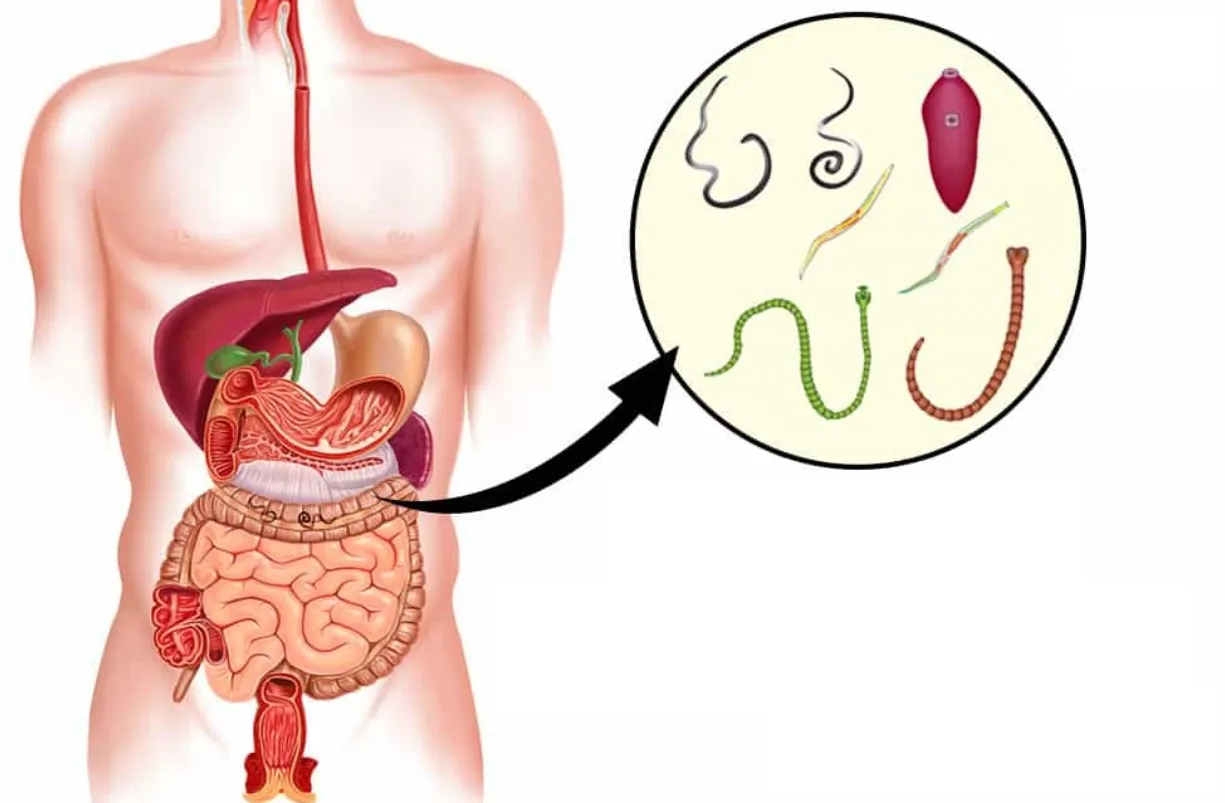
The larvae mature into adult worms, mainly in the ileocecal region, the cecum, the appendix area, and the colon. Adult worms are small, white, and thread-like. Females are larger than males and are responsible for egg laying.
Adult worms may live for about 2 months, though reinfection can make the infection appear continuous.
Stage 4: Egg-Laying and Reinfection Stage
At night, female worms migrate to the anal area and lay eggs. This creates itching, scratching, and contamination of hands and objects. If eggs return to the mouth, the same person becomes reinfected. This is called autoinfection.
This final stage is why enterobiasis treatment requires both medicine and strict hygiene. Medicine kills adult worms, but eggs in the environment can restart the cycle.
Their Main Diet, Food Sources, and Collection Process Explained
What Do Pinworms Eat?
Enterobius vermicularis is a parasitic nematode, so it does not hunt or collect food like a free-living animal. It lives inside the human intestine and obtains nutrients from the intestinal environment.
Adult pinworms are usually found in the intestinal lumen, especially around the cecum and colon. They are associated with intestinal contents and the mucosal environment. Their survival depends completely on the human host.
Food Source Inside the Host
The main “food source” for pinworms is not solid food collected independently. Instead, they absorb or ingest material available in the gut environment. This may include intestinal contents and nutrients present after human digestion.
No External Feeding Process
Pinworms do not leave the body to feed. The female only migrates outside the anus to lay eggs, not to eat. After egg deposition, the female worm usually dies.
Why This Matters for Infection Control
Diet changes alone do not reliably cure enterobiasis. Since the parasite’s life cycle depends on eggs, hygiene and medication are far more important than trying to “starve” the worms.
Common Misunderstanding
Some people believe sugar, milk, or certain foods directly “cause” pinworms. In reality, enterobiasis is caused by swallowing infective eggs. Food can become a vehicle only if it is contaminated with eggs from unwashed hands or dirty surfaces.
How Long Does an Enterobiasis Live
Strictly speaking, enterobiasis is the infection, while Enterobius vermicularis is the worm. So the better question is: how long does the pinworm live, and how long can the infection continue?
- Adult pinworms usually live for around two months. Research and clinical references commonly describe the adult lifespan as about two months, though some female worms may survive longer under suitable host conditions.
- Eggs can survive outside the body for 2 to 3 weeks. This is why bedding, underwear, towels, toilet seats, and toys can remain infectious if they are not cleaned properly.
- The infection can last longer than one worm’s life. Reinfection can happen repeatedly when eggs move from the anal area to fingers and then back to the mouth.
- Symptoms may continue if the egg cycle is not broken. Night itching can persist when new worms mature, and new females begin laying eggs.
- Medication usually requires a second dose. The second dose is commonly given two weeks after the first because medicines kill worms but not eggs.
- Household spread can restart the cycle. If one child is treated but siblings, caregivers, bedding, and surfaces are ignored, the infection may return.
- Good hygiene must continue after treatment. CDC prevention advice emphasizes handwashing, bathing, clean clothing, and household hygiene to prevent further spread.
- Untreated cases may appear chronic. This does not mean one worm lives for years; it usually means repeated autoinfection or repeated exposure.
Enterobiasis Lifespan in the Wild vs. in Captivity
In the “Wild” Human Environment
For Enterobius vermicularis, the “wild” environment is not a forest or soil ecosystem. It is the human household, school, daycare, or crowded living environment where eggs are spread among people.
In the human host, adult worms usually live for about 2 months. Outside the host, eggs can survive on indoor surfaces for about 2 to 3 weeks.
In Captivity or Laboratory Conditions
Pinworms are not normally kept in captivity like animals. In laboratory or controlled conditions, eggs and specimens may be studied for diagnosis, microscopy, or research. However, the natural life cycle still depends on a human host.
Why the Comparison Is Limited
Unlike insects, birds, or mammals, pinworms are obligate parasites of humans. They cannot complete their normal life cycle independently in soil, water, or open nature.
Practical Lifespan Summary
Inside humans, the worm stage may last weeks to months. Outside humans, the egg stage is the main survival form, lasting days to weeks depending on temperature, humidity, and cleaning conditions.
Importance of Enterobiasis in This Ecosystem
A Human-Parasite Relationship
Enterobiasis is not beneficial to humans, but it is important in the human microbial and parasitic ecosystem because it shows how easily parasites can adapt to daily human behavior.
The parasite’s success depends on close contact, hand-to-mouth movement, shared surfaces, and indoor living. This makes it a strong example of how hygiene affects disease transmission.
Public Health Importance
Enterobiasis is medically important because it spreads quickly in families, schools, and childcare settings. It is usually not dangerous, but itching, poor sleep, irritability, and repeated reinfection can affect quality of life.
Indicator of Hygiene Gaps
Pinworm infection can reveal gaps in handwashing, laundry practices, crowded sleeping arrangements, and child hygiene education.
Role in Medical Learning
The life cycle of enterobiasis is widely taught in parasitology because it clearly shows direct transmission, autoinfection, and environmental contamination.
Ecological Reality
From an ecological viewpoint, pinworms are part of host-parasite biodiversity. From a public health viewpoint, however, the goal is to prevent infection, not preserve the parasite in human communities.
What to Do to Protect Them in Nature and Save the System for the Future
Because Enterobius vermicularis is a human parasite, the aim is not to protect the worm. The responsible goal is to protect people, families, schools, and public health systems by reducing transmission.
Improve Hand Hygiene
- Wash your hands with soap and water after using the toilet.
- Wash your hands before eating or preparing food.
- Teach children to clean under fingernails.
Break the Egg Transmission Cycle
- Keep fingernails short.
- Avoid nail biting and scratching.
- Change underwear and sleepwear daily during treatment.
Clean Household Items Properly
- Wash bedding, towels, underwear, and pajamas in hot water when possible.
- Avoid shaking contaminated bedding, as eggs can spread into the dust.
- Clean bathroom surfaces and frequently touched objects.
Treat Correctly
- Follow healthcare advice for enterobiasis treatment.
- A second dose is often needed 2 weeks after the first because the first dose does not kill the eggs.
Protect Schools and Childcare Settings
- Encourage routine handwashing.
- Clean toys and shared surfaces.
- Inform caregivers when symptoms appear so reinfection can be controlled early.
Fun & Interesting Facts About Enterobiasis
- Enterobiasis is one of the most common human nematode infections worldwide, especially among children.
- The adult worm is called a pinworm because the female has a pointed tail.
- Many people with pinworm infection have no symptoms, allowing the infection to spread silently.
- The most famous symptom is nighttime anal itching, caused by female worms laying eggs around the anus.
- Pinworm eggs are microscopic, sticky, and easily transferred to fingers, bedding, toys, and clothing.
- Pets such as cats and dogs do not serve as natural hosts for human pinworm infection; humans are the natural hosts.
- The common diagnostic method is the tape test, usually done in the morning before bathing or using the toilet.
- The ICD-10 code for enterobiasis is B80.
- Reinfection is common because medicine kills worms but does not kill eggs.
- The entire infection cycle can persist in a household unless hygiene, laundry, cleaning, and treatment are coordinated.
Frequently Asked Questions (FAQs)
Q: What is enterobiasis?
A: Enterobiasis is a human intestinal infection caused by Enterobius vermicularis, commonly called the pinworm or threadworm.
Q: What are the main enterobiasis symptoms?
A: The main symptom is itching around the anus, especially at night. Other symptoms may include poor sleep, irritability, skin irritation, and sometimes vaginal itching. Some people have no symptoms.
Q: How does the life cycle of enterobiasis begin?
A: It begins when a person swallows microscopic pinworm eggs from contaminated hands, food, clothing, bedding, toys, or surfaces.
Q: What is the best enterobiasis treatment?
A: Common treatments include mebendazole, albendazole, or pyrantel pamoate. A second dose is often given after two weeks, and household hygiene is essential.
Q: What is enterobiasis ICD 10?
A: The ICD-10 code for enterobiasis is B80. It is also associated with pinworm (threadworm) infection.
Conclusion
The life cycle of enterobiasis is simple but highly effective. Enterobius vermicularis spreads when microscopic eggs move from the anal area to hands, surfaces, food, or bedding and are swallowed again. Inside the body, the eggs hatch, larvae mature, adult worms reproduce, and female worms lay new eggs around the anus at night.
Although enterobiasis is usually not life-threatening, it can cause itching, sleep disturbance, discomfort, and repeated household reinfection. The best control strategy combines accurate diagnosis, proper enterobiasis treatment, a second dose of medication when advised, and strict hygiene. Handwashing, short nails, clean bedding, daily changes of underwear, and household cleaning are the real keys to breaking the cycle.
For safe care, anyone with persistent symptoms, repeated infection, pregnancy, very young children, or complications should consult a qualified healthcare professional.
Also Read: life cycle of a hen