The life cycle of salmon is one of the most powerful migration stories in nature. Most salmon are anadromous fish, meaning they hatch in freshwater, migrate to the ocean to grow, and return to their birth river or stream to reproduce. This river-to-sea-to-river journey connects forests, oceans, wildlife, and people in one living system. NOAA describes Pacific salmon as fish that are born in freshwater, move through estuaries into the ocean, and then usually return to the same streams where they were born to spawn.
The word “salmon” does not refer to just one species. It commonly refers to several species in the family Salmonidae, including Atlantic salmon (genus Salmo) and Pacific salmon (genus Oncorhynchus). Britannica notes that Pacific salmon include species such as sockeye, coho, chum, pink, Chinook, and cherry salmon.
A salmon’s life is shaped by water temperature, river gravel, predators, food availability, ocean conditions, and migration routes. Their life cycle may look simple—hatch, migrate, spawn, die—but each stage is biologically complex. In the wild, salmon support bears, eagles, marine mammals, forests, and stream food webs by moving ocean nutrients inland.
Quick Answers: Most Common Questions
Q: What are the main stages in the life cycle of salmon?
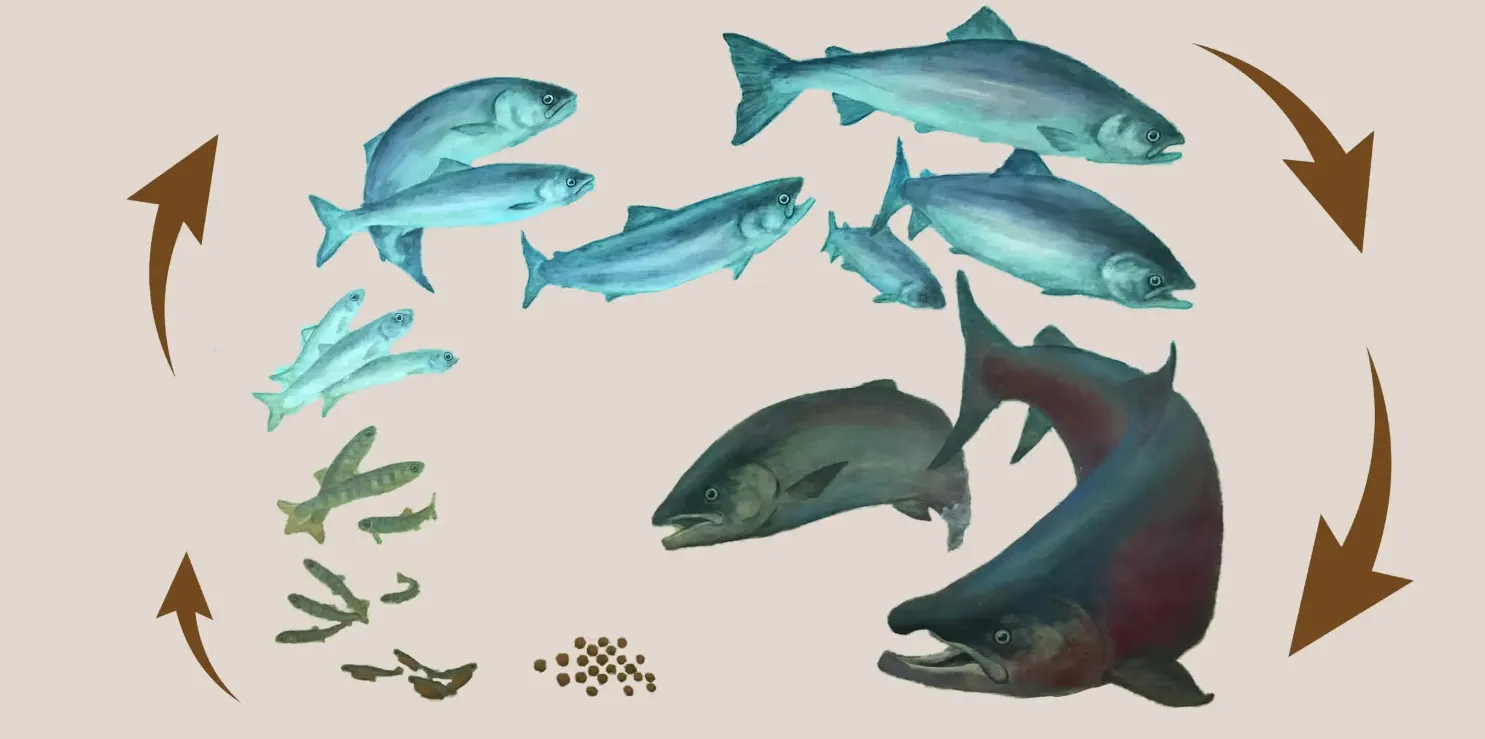
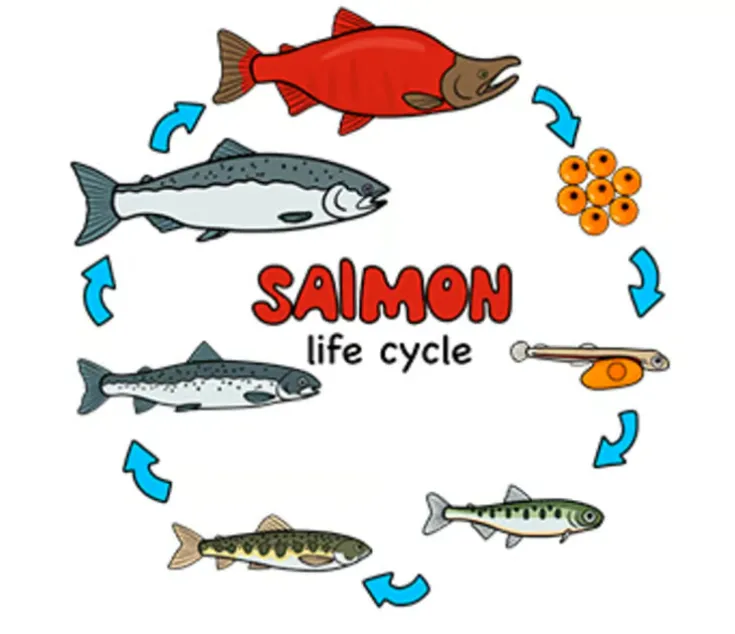
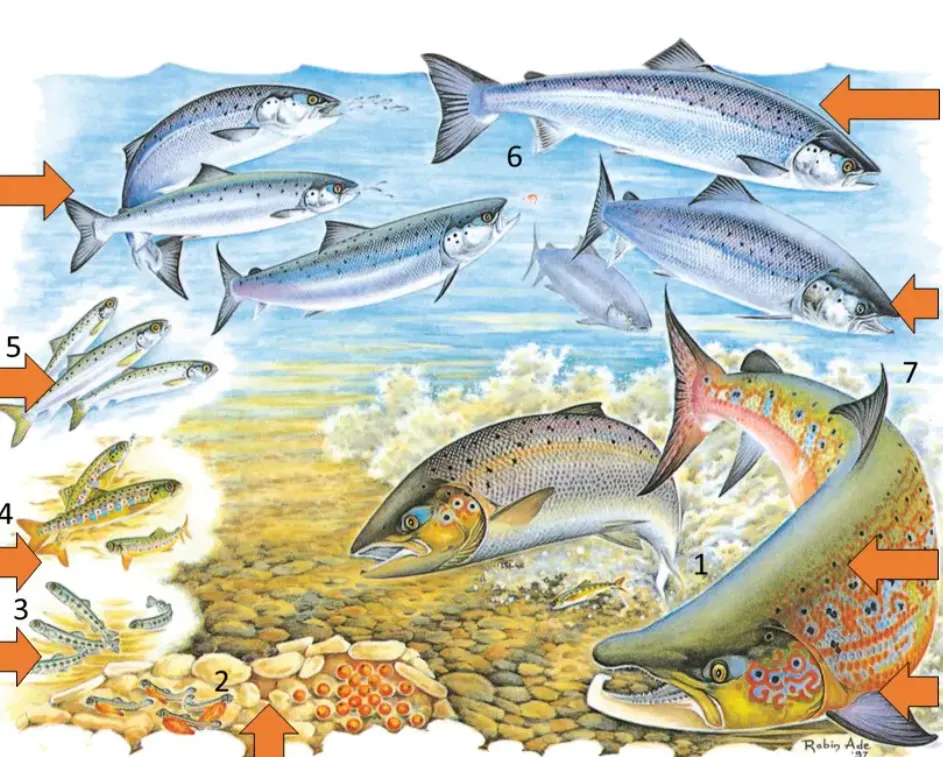
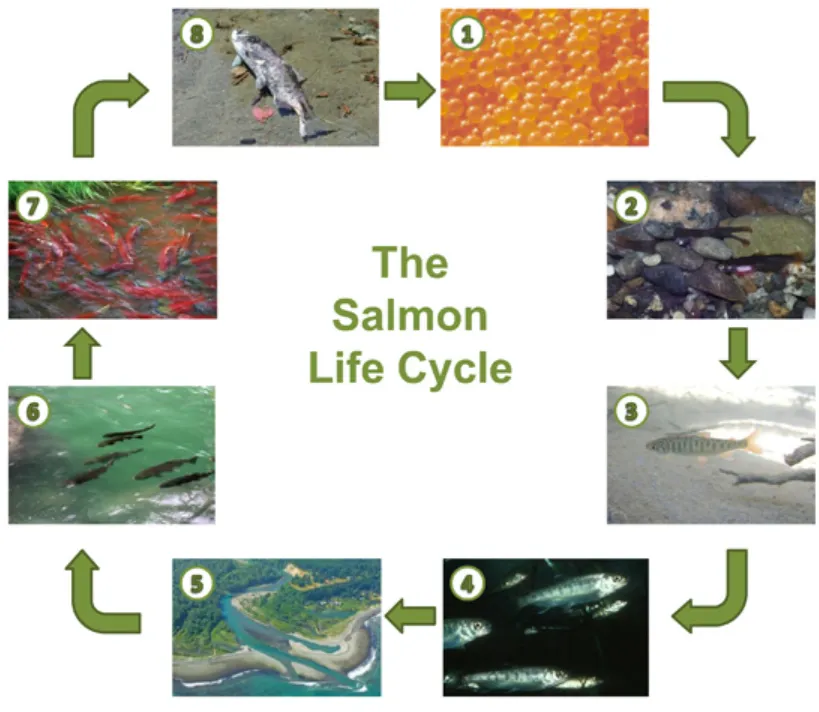
A: The main stages are egg, alevin, fry/parr, smolt, ocean adult, and spawning adult. For easier learning, these can be grouped into four big phases: freshwater birth, juvenile growth, ocean migration, and adult spawning.
Q: Do all salmon die after spawning?
A: Most Pacific salmon die after spawning, and their bodies return nutrients to the stream ecosystem. Atlantic salmon do not always die after spawning and may spawn again, although repeat spawning is now less common in many populations.
Q: How long does a salmon live?
A: Lifespan depends on species. Pink salmon often complete their life in about 2 years, while Chinook salmon may live 3 to 7 years. Sockeye salmon often spend 1–3 years in freshwater lakes and 2–3 years at sea before returning to spawn.
Important Things That You Need To Know
Many people search for salmon to understand both the fish in the wild and those raised for food. These are connected, but they are not the same topic. The life cycle of salmon explains how salmon grow, migrate, reproduce, and support ecosystems. Cooking questions explain how people safely prepare salmon after it is harvested or farmed.
For kitchen safety, the USDA lists fish and shellfish as safe at a minimum internal temperature of 145°F / 62.8°C. This matters to anyone searching for salmon internal temperature, especially when learning how to cook salmon at home.
If you are preparing salmon in an air fryer, use temperature rather than only time. Fillet thickness, air fryer model, and whether the fish is frozen or thawed all change the cooking result. The same rule applies when learning how to bake salmon or air fry salmon: check that the flesh is opaque and flakes easily.
Sockeye salmon is a popular wild species because of its deep color and rich flavor. It is also biologically fascinating because many sockeye spend their juvenile stage in freshwater lakes before going to sea.
Salmon patties are usually made with cooked, canned, or leftover salmon. They are a food topic, not a life-cycle stage, but they remind us that salmon are also important to human diets, coastal economies, and cultural traditions.
Quick Life Cycle Table
| Life Stage | What Happens |
| Egg | Female salmon lay eggs in gravel nests called redds. |
| Alevin | Newly hatched salmon stay hidden in gravel and live from their yolk sac. |
| Fry / Parr | Young salmon begin swimming, feeding, and growing in streams or lakes. |
| Smolt | Juveniles undergo physical changes to survive in saltwater. |
| Ocean Adult | Salmon feed, grow fast, and store energy for migration. |
| Spawning Adult | Mature salmon return to freshwater, reproduce, and many die afterward. |
| Ecosystem Return | Dead salmon feed wildlife and release marine nutrients into rivers and forests. |
The History of Their Scientific Naming, Evolution, and Origin
Scientific Naming of Salmon
The common name “salmon” covers several related fish, not a single species. The best-known scientific names include Salmo salar for Atlantic salmon and species of Oncorhynchus for Pacific salmon.
The genus Salmo is mainly associated with Atlantic salmon and some trout, while the genus Oncorhynchus includes Pacific salmon such as Oncorhynchus nerka (sockeye) and Oncorhynchus tshawytscha (Chinook). Britannica explains that the name salmon originally referred to Atlantic salmon and later came to be widely used for Pacific salmon species, as well.
Evolutionary Origin
Salmon belong to the cold-water fish family Salmonidae. Their ancestors evolved traits that helped them survive in rivers, lakes, estuaries, and oceans.
Pacific salmon are especially shaped by changing coastlines, glaciation, river formation, and ocean conditions. Scientific reviews describe Pacific salmon evolution as closely tied to dynamic environments, in which local river systems fostered adaptation and population diversity.
Why Their Origin Matters
The origin of salmon explains why each river population can be unique. A salmon run is not just “fish returning.” It is a locally adapted group carrying genetic memory of a specific watershed, temperature range, migration path, and spawning ground.
Their Reproductive Process, Giving Birth And Rising Their Children
Salmon Do Not Give Live Birth
Salmon do not give birth like mammals. They reproduce by laying eggs. A female salmon uses her tail to dig a shallow gravel nest called a redd in clean, flowing freshwater.
NOAA explains that adult salmon spawn in freshwater, where females lay thousands of eggs and males fertilize them. The eggs are then buried in gravel, where they develop for weeks to months, depending on species and water conditions.
Fertilization Happens Outside the Body
When the female releases eggs, the male releases milt, which contains sperm. Fertilization happens in the water. Afterward, the female covers the eggs with gravel to protect them from predators and strong currents.
Good spawning gravel is extremely important. If sediment fills the spaces between stones, oxygen flow drops, and developing embryos may not survive.
No Parental Care After Spawning
Salmon do not raise their young directly. They protect the next generation primarily by choosing the right spawning site and carefully burying the eggs.
In most Pacific salmon, adults die after spawning. Their decomposing bodies enrich streams with nutrients, helping feed insects, young fish, plants, and surrounding wildlife. The National Park Service highlights this anadromous life strategy as a way salmon bring nutrients from the ocean back into rivers and wildlife communities.
Atlantic Salmon Are Different
Unlike Pacific salmon, Atlantic salmon may survive spawning and return to the ocean. NOAA notes that Atlantic salmon can migrate several times to spawn, although repeat spawners are increasingly rare.
Stages of the Life Cycle of Salmon
Stage 1: Egg and Alevin
The life cycle of salmon begins when fertilized eggs are buried in cold, clean freshwater gravel. These eggs need oxygen-rich water moving gently through the gravel.
After hatching, the young salmon is called an alevin. At this stage, it looks fragile and carries a yolk sac attached to its belly. The yolk sac serves as a natural food source, allowing the alevin to remain hidden under gravel as it develops.
This hidden stage is dangerous. Floods, low oxygen, sediment, predators, and temperature changes can reduce survival. Healthy rivers with clean gravel are essential for the beginning of the salmon life cycle.
Stage 2: Fry and Parr
Once the yolk sac is absorbed, the young salmon emerges as a fry. Fry begin feeding on tiny aquatic insects, plankton, and other small organisms.
As they grow, many become parr, a juvenile stage marked by dark vertical bars called parr marks. These markings help camouflage young salmon in streams. The Marine Institute notes that parr feed on aquatic insects and may live in streams for 1 to 3 years before smolting.
This stage is about learning to survive. Young salmon must avoid birds, larger fish, poor water quality, and sudden habitat changes.
Stage 3: Smolt and Ocean Migration
The smolt stage is one of the most important transitions. Smolting prepares salmon for saltwater. Their bodies change how they handle salt, their color becomes more silvery, and their behavior shifts toward downstream migration.
The Pacific Salmon Foundation explains that smolting helps young salmon move through estuaries and into the ocean, while silvery scales help camouflage them from predators.
Estuaries are critical nursery zones. They give smolts time to acclimate from freshwater to seawater and provide food before they enter the open ocean.
Stage 4: Ocean Adult and Spawning Adult
In the ocean, salmon feed heavily and grow quickly. Depending on the species, they may spend one to several years at sea. Adult salmon then return to freshwater when they are ready to spawn.
Many salmon use smell and environmental cues to locate their home stream. During migration, they may stop feeding and use stored energy to swim upstream, leap barriers, fight currents, and reach spawning grounds.
After spawning, most Pacific salmon die, completing the cycle and feeding the next generation indirectly through the ecosystem.
Their Main Diet, Food Sources, And Collection Process Explained
What Young Salmon Eat
Young salmon fry and parr feed mostly on small freshwater organisms. Their diet may include zooplankton, aquatic insect larvae, terrestrial insects that fall into the water, amphipods, and small crustaceans.
NOAA notes that juvenile sockeye salmon in freshwater mainly eat zooplankton, amphipods, and insects. This diet gives them the protein and energy needed to grow before migration.
What Ocean Salmon Eat
In the ocean, salmon become stronger predators. Their diet expands to include zooplankton, larval fish, small adult fish, squid, and crustaceans. Sockeye salmon continue eating zooplankton at sea, but also eat small fish and sometimes squid.
Different species have different feeding styles. Sockeye often rely heavily on plankton and small crustaceans. Chinook and coho may eat more fish as they grow larger.
How Salmon Collect Food
Salmon collect food by sight, movement detection, and active hunting. Juveniles hold positions in currents and snap up drifting prey. In lakes, sockeye may filter and chase tiny plankton.
In the ocean, adult salmon search for prey-rich zones where currents gather krill, small fish, squid, and other food. Their feeding success affects body size, migration strength, egg production, and survival.
Why Does Diet Affect the Whole Life Cycle
A salmon’s diet is not just about growth. Food quality affects whether juveniles survive smolting, whether adults return strong enough to spawn, and how many eggs females can produce.
How Long Does A Salmon Live
The lifespan of salmon depends strongly on species, habitat, water temperature, food supply, and whether the fish is wild, farmed, or hatchery-raised.
Most salmon live between 2 and 7 years, but there is no single lifespan that applies to all salmon.
- Pink salmon often have the shortest and most predictable life cycle. Many return to spawn as 2-year-old fish, creating strong odd-year or even-year runs in some regions. The Alaska Department of Fish and Game notes that pink salmon follow a two-year cycle.
- Chinook salmon, also called king salmon, often live longer than other Pacific salmon. The Alaska Department of Fish and Game lists the Chinook lifespan as 3 to 7 years.
- Sockeye salmon commonly spend 1 to 3 years in freshwater lakes before becoming smolts, then often return after 2 to 3 years at sea, though some return earlier or remain at sea longer.
- Coho salmon often complete their cycle in about three years in many populations, though timing varies by region and environmental conditions.
- Atlantic salmon can live longer than many Pacific salmon because some survive spawning and return to sea. However, survival after spawning is not guaranteed, and repeat spawning has become less common in some wild populations.
- The lifespan of wild salmon is shaped by predators, drought, floods, warm water, blocked migration routes, fishing pressure, and ocean food availability.
- Farmed Atlantic salmon are usually harvested before they reach a natural old age. A major salmon farming industry handbook describes the commercial production cycle as roughly 3 years, with freshwater growth followed by seawater growth to harvest size.
- Hatchery salmon may begin life in controlled conditions, but many are released into the wild and then face the same ocean and migration risks as wild salmon.
- Climate change can indirectly shorten survival by warming streams, reducing snowpack-driven flows, increasing disease risk, and altering ocean food webs.
- The longest-lived salmon are not always the most successful. In salmon biology, success means returning to spawn and producing the next generation.
Salmon Lifespan in the Wild vs. in Captivity
Wild Salmon Lifespan
In the wild, salmon lifespan is controlled by natural selection. From the egg stage onward, survival is difficult. Eggs may be buried by sediment; birds or larger fish may eat fry; smolts may die during estuary migration; and adults may face predation by marine mammals, fishing pressure, disease, and blocked rivers.
Wild salmon that survive become highly adapted migrants. Their lifespan may range from about 2 years in pink salmon to 7 years in some Chinook salmon.
Captive and Farmed Salmon Lifespan
In captivity, the most common salmon is Atlantic salmon raised for food. Farmed salmon are not usually kept to their natural lifespan. They are raised through freshwater hatchery stages, transferred to seawater grow-out systems, and harvested at market size.
Commercial production typically takes about 2–3 years, depending on the farming system, water temperature, feed, and the harvest target.
Key Difference
Wild salmon live according to their migratory and reproductive cycles. Captive salmon live according to production schedules, breeding programs, and controlled feeding. This means “lifespan” in captivity usually refers to time to harvest, not the natural biological lifespan.
Importance of Salmon In This Ecosystem
Salmon Move Ocean Nutrients Inland
Salmon are often called ecosystem connectors because they move nutrients from the ocean into rivers, forests, and mountain watersheds. When adult salmon return to spawn and die, their bodies release marine-derived nutrients into freshwater habitats.
NOAA describes Pacific salmon as a keystone species that benefits other species as food and enriches habitats through nutrient cycling from the ocean to freshwater streams.
They Feed Wildlife
Salmon are food for bears, eagles, otters, seals, sea lions, orcas, larger fish, and many scavengers. Even young salmon feed on birds and predatory fish.
This makes salmon a central energy source in both freshwater and marine food webs.
They Support Forests and Rivers
Salmon carcasses feed aquatic insects, microbes, and plants. Bears and other animals carry salmon into forests, spreading nutrients beyond the stream edge.
The National Park Service explains that salmon’s anadromous strategy helps bring ocean nutrients back into rivers and wildlife communities.
They Support People and Culture
Salmon are vital to Indigenous communities, commercial fisheries, recreational fisheries, local food systems, and coastal economies. Protecting salmon also protects clean water, healthy forests, and functioning rivers.
What To Do To Protect Them In Nature And Save The System For The Future
1. Protect Clean, Cold, Freshwater
- Salmon eggs and juveniles need clean, oxygen-rich water.
- Restoring streamside trees helps shade rivers and keep water cool.
- Reducing pollution, road runoff, and excess sediment improves spawning success.
2. Remove or Improve Fish Barriers
- Dams, culverts, and blocked channels can prevent salmon from reaching spawning habitat.
- NOAA identifies dams and culverts as major threats to Atlantic salmon because they block access to quality habitat.
- Fish ladders, culvert replacement, and dam removal can reopen migration routes.
3. Restore Spawning and Estuary Habitat
- Healthy gravel beds protect eggs.
- Wetlands and estuaries help smolts adjust from freshwater to saltwater.
- Reconnecting side channels gives young salmon shelter from floods and predators.
4. Support Responsible Fishing and Seafood Choices
- Follow local fishing limits and seasonal rules.
- Choose responsibly sourced salmon when buying food.
- Avoid wasting harvested fish because salmon are ecologically and culturally valuable.
5. Take Climate and Watershed Action Seriously
- Warmer water stresses cold-water salmon.
- Protecting forests, reducing water waste, and improving river flow can help.
- A real-world restoration example is the Klamath River, where the removal of four large dams reopened about 400 miles of historic salmon habitat.
Fun & Interesting Facts About Salmon
- Salmon can return to their birth stream. Many use smell and environmental cues to locate the river or stream where they hatched.
- Sockeye salmon turn bright red. Ocean-phase sockeye are silver-blue, but spawning adults often become red-bodied with greenish heads.
- Pacific salmon usually die after spawning. Their death is not wasted; it feeds streams, forests, insects, and wildlife.
- Atlantic salmon may spawn more than once. Unlike most Pacific salmon, some Atlantic salmon survive and return to sea after spawning.
- Smolting is a major body transformation. Smolts undergo internal changes to survive saltwater after growing in freshwater.
- Chinook are the largest Pacific salmon. Their longer lifespan and ocean-feeding period help them reach impressive sizes.
- Salmon connect land and sea. Few animals link ocean food webs so clearly with inland forests.
- A salmon’s color comes partly from its diet. Pigments from crustaceans and other prey help influence the orange-red flesh color.
- Not all salmon life cycles are identical. Species, river systems, climate, and ocean conditions all shape timing.
- Protecting salmon protects more than fish. It supports clean water, wildlife, fisheries, and future food systems.
Frequently Asked Questions (FAQs)
Q: What is the life cycle of salmon in simple words?
A: The life cycle of salmon begins as eggs in freshwater gravel. They hatch into alevin, grow into fry and parr, transform into smolts, migrate to the ocean, grow into adults, then return to freshwater to spawn.
Q: Why do salmon return to the same river?
A: Salmon return because they are strongly adapted to their birth watershed. Many use smell and environmental signals to find their natal stream. This behavior helps each population stay connected to suitable spawning habitat.
Q: What is the most dangerous stage of the salmon life cycle?
A: Every stage is risky, but the egg, smolt, and return migration stages are especially dangerous. Eggs need clean gravel, smolts must survive estuaries and predators, and adults must reach spawning grounds despite barriers and exhaustion.
Q: Are sockeye salmon part of the salmon life cycle topic?
A: Yes. Sockeye salmon are among the best examples of the salmon life cycle because many hatch in freshwater systems, rear in lakes for 1–3 years, migrate to the sea, and then return to spawn.
Q: How does the salmon life cycle help the ecosystem?
A: Salmon carry ocean nutrients into freshwater and forest ecosystems. Their eggs, juveniles, adults, and carcasses feed many animals, and their migrations support river health, wildlife, and human communities.
Final Word
The life cycle of salmon is much more than a fish story. It is a complete natural system that begins in cold freshwater gravel, expands into rivers and oceans, and returns home through one of nature’s most remarkable migrations. From egg to alevin, from fry to smolt, and from ocean adult to spawning parent, salmon show how survival depends on clean water, healthy habitat, strong migration routes, and balanced ecosystems.
Understanding salmon helps us understand rivers, forests, oceans, wildlife, and even human food choices. When salmon thrive, many other species benefit. When salmon decline, the whole system feels the loss.
Protecting salmon means protecting clean streams, cool water, connected rivers, responsible harvests, and future biodiversity. Their journey is ancient, difficult, and deeply important—and saving it is one of the clearest ways to protect nature for future generations.
Also Read: life cycle of fleas